Showing posts with label video games. Show all posts

Friday, April 26, 2013

Sex, Sex, Sex, Sex, Sex, SEX, Sex, Sex, Sex, Sex (and a Video Game called Catherine!)

Pretty much a currency in my house.

It has been pretty typical, in the past, when birthdays or Christmas come around, for us to want to get each other more presents than we really have money for. I doubt my family is unique in this regard! In fact, there have been a couple of years where my wife and I haven’t gotten each other anything for Christmas, instead buying gifts for each other whenever we get our tax refund in a couple of months later.

In line with this, there have been a number of instances over the years when I have been gifted or traded vague future promises of a subscription to video game-by-mail rental service Gamefly for this or that. If my wife wasn’t able to get  me much for my birthday, I’d get a month of Gamefly. Or sometimes she would trade me a month or two in exchange for taking her to Olive Garden or something. I can’t possibly tell you now how many months of Gamefly I am “owed.” I think that’s partially the point. But I was just able to cash in on a few months of it, and play a handful of games I was curious about or simply hadn’t received as a present (the manner in which I receive virtually all the video games I own; my Dad loved the commercials for Assassin’s Creed III so much that he was as excited when he got it for me as I was!). There was one game that I knew was going to be added to my rental queue the next time I got to cash in on some Gamefly. It’s called Catherine, it came out in 2011, and it is the inspiration for today’s theofictionology post.
Not pictured: Custer's Revenge.
Pictured: Butterflies.

If you’ve seen the cover art or any of the advertising for Catherine, you’re probably thinking it’s an odd choice for a young man of God to want to play. The marketing for the game is very clear about having sexual themes. Honestly, that’s one of the reasons I was interested in it. Now, of course, pornographic games do exist. One of the most famous is an old game called Custer’s Revenge; in it, the player controls General Custer who needs to evade arrow so he can get to a naked American Indian woman tied to a post and rape her.


You know, it sounds pretty bad when you lay it all out like that.

Yes, I will show you the Catherine cover art,
but with the understanding that you had
better not enjoy it.
And, no, I haven’t played it. But Catherine was nothing like this. Despite the cover art—and the frantic, almost cheesy anime aesthetic that the game sometimes indulges in—reviews praised it as a mostly mature attempt to explore adult themes in a video game. I even read an article in which playing the game inspired one gamer to come clean about infidelity in his past. And as a pretty hardcore gamer, there was no way I could ignore a game that was making a serious issue to take on a subject that games too often take a juvenile stance on, if at all.

I hope this goes without saying, but the movies, books, TV shows and games I discuss on this blog are never intended as an endorsement. Well, unless I recommend you go out and get them, and I do that sometimes with the books I read. But I’m not suggesting you rush out and buy Catherine and I’m sure as heck not suggesting you rush out and buy it for your teenage son. On this blog, our interest is in seeing what spiritual conversations can arise from fiction of all stripes. If you’re interested in the moral content of something like Catherine, I recommend checking out a site that specializes in that, such as CommonSenseMedia.org (here’s their take on Catherine). There are also Christian sites out there that do the same, but I’ve found some of them that get pretty darn silly and incredibly petty. Now back to our regularly schedule blog post.

Seriously, the game was a lot of fun to play!
Catherine features Vincent, a 32-year-old man who has been in a long-term relationship with his girlfriend Katherine but is very squeamish about committing further. No sooner does she start pressuring him for a more formal commitment than he suddenly finds himself waking up next to the buxom, perky Catherine after a night together he doesn’t even remember. His newfound relationship corresponds to intense, vivid nightmares in which he has to use a variety of tricks to climb to the top of a tower. The bottom floors start
dropping on a regular basis and sometimes monsters chase him. It’s a strange game.

It’s also a game in which the player is forced to deal with infidelity. They are not given a choice whether they want to stay faithful to Katherine—at least, not initially—so they need to deal with it. You can encourage or discourage the sexy Catherine (who, initially, I liked a lot better than Katherine, personality-wise). You can be loving or cold to your girlfriend. The choices aren’t nearly as pronounced as they are in Mass Effect or Skyrim, for instance, and sometimes I was annoyed that none of my options really lined up with what I wanted to say (or text someone, more likely), but I got over that. Plus, the climbing puzzler gameplay was surprisingly compelling—and difficult! But it was very satisfying to make it to the top. I enjoyed the game, and it gave me a taste of something that I never intend to sample in real life: I walked in the shoes of a cheater.
So you don't feel cheap, I've even invited Barry White
to swing by and set the mood with a little music.

So where are we going with this? Well, where do you think? Let’s talk about sex. 

I’ve noticed something in regards to TV shows and movies. I think we all can agree that Christian characters are often established simply to make fun of them. I would point out that real life is like that sometimes too; otherwise, why is Fred Phelps around? But sometimes a writer does explore someone with faith in a manner that goes beyond easy punchlines. The Shield has one of the best examples I can think of, in which police officer Julian struggles to balance his faith with his homosexual feelings. The writers treated him with respect and his personal battle added some real depth to his character and the show. Other TV shows that have treated Christian characters with respect include The Middle and Firefly.

But even when writers decide that Christians are people too and want to write them with sympathy, I have noticed that one of the concessions they often seem to make is that the believers in the show have no problem with premarital sex. Maybe I’m reading too much into this, but the message that I’m taking away is that, if we’re going to accept Christians as a decent human being, they need to consider the biblical prohibition against sex outside of marriage as antiquated and not relevant.

I would argue that it’s very relevant.

They decided to wait to have sex.
And, no, the fact that she is now a
Maxim cover girl does nothing to negate that.
When I was growing up—and some of you youngsters are going to think I’m yanking your yank-chain—it was normal for a teenage couple on a television show to struggle with whether they were going to actually have sex or not. The times were a-changing so they didn’t all opt to abstain, but it was a question, not a given. Cory and Topanga wrestled with it on Boy Meets World; even Angela Chase and bad boy Jordan Catalano struggled with the question in the acclaimed and aptly-titled episode “Pressure” of the quickly-canceled My So-Called Life. This wasn’t that long ago. How things have changed in our fictional worlds.

We would be naive to think that Christian culture doesn’t change with the rest of the world. Barna Group research indicates that nearly 60% of born again believers do not see a moral problem with premarital sex or living together outside of marriage. For those of you who aren’t taking a stats class right now (I have to mention that because fellow author Cynthia P. Willow, whom I interviewed a couple of months ago, is taking one and hates it), that means a majority of Christians in their twenties and thirties do think biblical prohibitions on premarital sex are antiquated and not relevant. Which I guess means I owe TV writers an apology! Their portrayal of modern Christians is right on the money.

I’m not going to belabor this point. I just want to make a couple of arguments, and then you can go on your merry, sexy way. Or your married, sexy way. That’s even better!

First argument: The Bible is very clear that you do not mess around when it comes to sex. I love to draw this comparison. When it comes to the Prince of Darkness, the devil himself, have you noticed the Bible’s instructions on how to deal with that old goat?

“Resist the devil, and he will flee from you.” - James 4:7

Of course, if the devil comes at you with sex,
things do get a bit confusing.
I love that! It’s wonderful, isn’t it? Let’s drop all this “the devil made me do it” crap. As a follower of Jesus Christ, your Master defeats ol’ Belial handily. You resist him, he flees. It’s wonderful.

But when it comes to sex, our instructions are a bit different:

“Flee from sexual immorality!” - 1 Cor. 6:18

Hold on. The devil was just fleeing in the last verse. Now we’re the ones who have to flee? What’s up with that!?

Satan comes at you with both barrels, resist him. With the Holy Spirit, you are stronger than him. A sexy lady or hunky Christian author starts giving you the googly eyes? Get the heck out of Dodge. You can’t handle this. When it comes to sexual temptation, get out of there. It will destroy you.

Second argument: Sexual sin can never be taken back. Of course, there are other sins like this—murder comes to mind—but often it is possible to make amends. If you lie, you can turn around and tell the truth. If you steal, you can return what you stole, or the value of it. I’m not saying it’s as cut and dry as that and there are always consequences, but sexual sin is not something you can ever go back on.

Let me give you a scenario. You’re a young  man who grew up in the church. You know what’s right and wrong but you’re super horny so you go ahead and have sex with your high school girlfriend. When you get to college, you get involved with Navigators (they disciple you!) and decide to really stop screwing around—
How can you even think about
letting her down?!
both sexually and in your faith. You repent, of course, and God forgives you—there is no doubt about that!—and you start living life for Him. Of course, as a man of God, you find your eye caught by a woman of God. And she’s been doing this longer than you, so she will be pure on your wedding day, never having been intimate with another.

You cannot give that to her. It’s too late. You two can get past it, of course, and I think you will. You and God already have, you might recall. But I guarantee you that the grief and regret you feel on your wedding night will overwhelm the temporary pleasure you got from getting frisky in the back of your Dad’s Subaru. No contest.

The third argument plays off the second. I think I first got this one from the youth ministry curriculum guide The Seven Checkpoints by Andy Stanley and Stuart Hall (a book I really liked when I did youth ministry). I’m bringing it up here because the response I hear most often is, “Huh. I never thought of that.”

Not pictured: Unspecified sex act.
Pictured: cute puppies in a basket.
Most of the people I know, Christian or not, desire a healthy, committed marriage someday in their future. Unless you really make your wife mad a lot, sex is one of the benefits of a healthy marriage. But sex outside of marriage corrupts your relationship in a way that you’ve probably never considered. Your sexual relationship with your spouse can never really stand on its own, because it is pretty darn near impossible to never bring in comparisons. You can’t help but think, to some extent, “Oh, I liked it better when [random ex-girlfriend] did [unspecified sex act] than how [random current wife] does it.”


Are you feeling romantic yet?

Now think about your spouse having those same thoughts. If you follow God’s plan, your relationship with your spouse will be great and satisfying in part because you’ll have nothing to compare it to. The more sexual partners you’ve had in the past, the more room there is for comparison. Is that something you want?

Of course, if you’re reading this blog, there’s a good chance that you consider yourself a follower of Jesus Christ. Sin in our life always separates us from God. We all struggle with different sins, too, and it’s quite possible that I struggle with sexual sin more than you do. Well, whatever your poison is, letting that in your life hinders your relationship with God and prohibits you from doing what you were put her to do: to be salt and light, to reach others for the Kingdom of God. That’s a big deal.

In the spirit of full disclosure, our soap
doesn't even come in a box.
I know I need to get off my little soapbox. We’re supposed to be talking about a video game after all, a video game in which the blanket assumption is sex outside of marriage because that’s the world in which we live (I can’t even say “culture” since this Catherine is a Japanese game). When we are so completely inundated with the same message—for example, that sex is not designed to be enjoyed only in a marriage relationship—we tend to start to believe it, just from the sheer repetition. Even if it’s a lie.

So thanks for listening to me chat about sex. My advice to you? Chat about it yourself. Christians need to get past their discomfort with this issue and bring it out in the open, because the enemy is not squeamish about it which means theirs is the loudest voice being heard (and sorry for being so melodramatic, but that’s the way it is). If we let the media do all the talking, then Christian young adults are going to internalize its message, not the truth of Scripture. This is true in all areas, but I don’t think I know another topic where so many believers are too embarrassed to speak up.

Heck, play Catherine side-by-side with your  kid if it helps. Pause the game and talk about how the sexual situations in it differ from what the Bible has to say. Give them solid reasons to follow God instead of the world. Be open about your own failures in this arena and they heartache that it has caused. But whatever you do, address it.

"I am so turned off right now!"
"Not as turned off as I am!"
Who knows? Maybe having all these old people talking about sex a lot will make the young ones so
embarrassed that they can never get in the mood again! Sure, the human race would die out without anyone procreating, but it’d still be a win for morality! Huzzah!

Oh! I just got a thought. I wonder, if I let my wife pick where we go to lunch tomorrow, if I might get another month of Gamefly out of it...it’s worth a try...

Addendum: I realized after writing this that there were times when I implied that I thought this was a teen or young adult issue. It’s not. It’s a spiritual issue. God designed sex for marriage whether you’re seventeen or seventy. Violating His principles will always hinder your relationship with Him, no matter your age; more than that, I would argue that going against your Creator will almost always have negative consequences as well. He made you. He knows how you work. He made sex. He knows where it belongs. Are you going to tell Him that you know better? Huzzah!

Sunday, January 6, 2013

Spiritual Stacking to Save Suffering Souls

One of these individuals has
 fine leather jackets for sale.

I very much enjoy playing games that are full of puzzles. I grew up as a point-and-click adventure gamer on the computer and used to spend hours playing King’s Quest V and the Monkey Island and Gabriel Knight games. I’ve moved almost exclusively from computer to console over the years, which means there are very few old school adventure options, although I have been getting back into some PC gaming for Telltale’s excellent take on Monkey Island and I’d also be lying if I said I didn’t enjoy Her Interactive’s Nancy Drew series. Yes, I realize I’m the wrong gender to play the latter, but I enjoy them nonetheless, plus I love the game designer’s old slogan: “For girls who aren’t afraid of a mouse.”

I guess this girl couldn't find her XBox controller.
Now, I know what you’re thinking. There are indeed puzzle games on consoles, although not usually of the point-and-click adventure style (which really works better with a keyboard-and-mouse setup anyway). This is true, but the bulk of my gaming these days takes place while I am exercising. I do step exercises and play the 360 while I step. It gives me time to play and—since I rarely get other time to game—helps motivate me to exercise. The problem is that I’m not smart or coordinated enough to play puzzle games while I work out. My stepping slows down and sometimes comes to a halt altogether while I’m trying to figure out how to complete a challenge or finish a level. I absolutely love both Portal games, but it’s difficult to play them while exercising so I had to squeeze them in at other times (like in the middle of the night, when my time is actually supposed to be set aside to write).

I have been *all* those characters. It just struck me
that this game might be a complex metaphor
for schizophrenia.
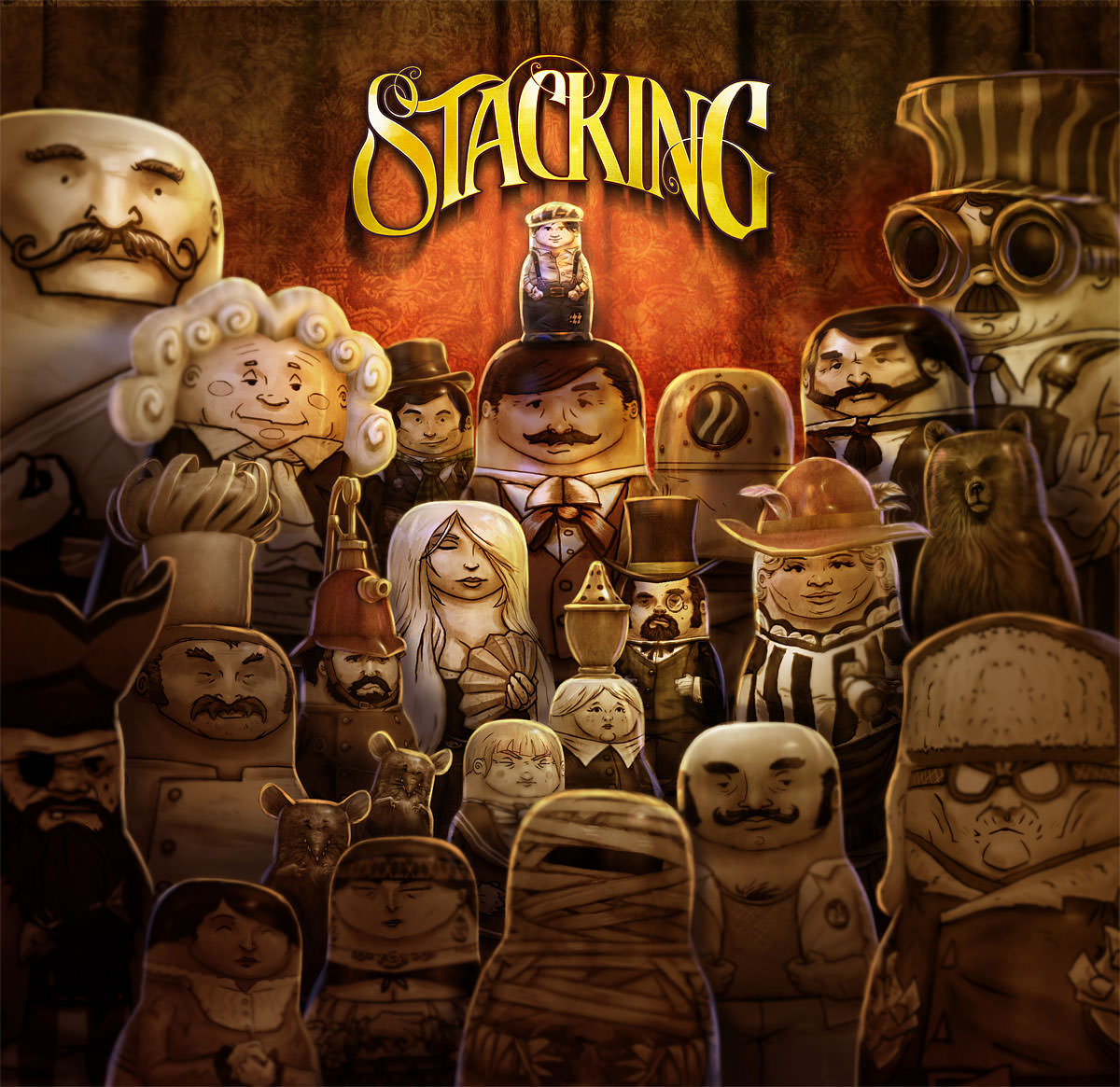
One very enjoyable console puzzle game that’s come out in recent years that I have found time to squeeze in is the Russian doll adventure puzzler Stacking. Although I could have done without the occasional bout of bathroom humor, I found the game to be pretty delightful. It has a completely unique gameplay dynamic. You play as a tiny little Russian stacking doll named Charlie. He’s so small that everyone underestimates him, but his tiny size gives him a unique ability: he can “stack” into other dolls, controlling them and solving puzzles through their different traits and attributes. There are five or six doll sizes, and Charlie can always stack into the next larger doll. So if he’s a size one, he can stack into any size two; as a size two, he can stack into any size three doll, and so on. Maybe he stacks into a doll who is goes around punching other dolls, or maybe he can clear a room by stacking into a doll with really bad gas. He can fly to certain places by stacking into a bird doll. No bird dolls around? Stack into a fish and flop about until you get one’s attention.

It’s charming, it’s funny and it’s full of interesting puzzles. One of the things I really like about the game is that each puzzle has multiple solutions. You’re encouraged to find them all. So maybe you clear that room by being Mr. Farty Pants on your first try, but then on the next try you can let such a draft into the room that everyone gets cold and leaves. Solving a puzzle one way is an achievement but it’s only the tip of the iceberg. You can only solve all the challenges by experimenting with different dolls and special activities, by deciding what each situation requires and fulfilling those requirements.

It might not be surprising that I thought several times while playing of Paul’s testimony that he became “all things to all people, that by all means I might save some” (1 Cor. 9:22). It’s probably not an unfamiliar passage, but is it one that is represented in our lives?

Just look at those little beady eyes. You just
know he's planning on reaching out to
people you don't care for. The nerve!
I know it’s controversial in some circles (particularly in certain circles in which people have nothing better to do than sit around and criticize other believers), but I agree with Rick Warren’s contention in The Purpose-Driven Life that we must deliberately and intentionally live our lives according to God’s purposes if we do not want to waste our time on this earth. Most video games thrive on purpose (with the notable exception of certain open world games that can be played a variety of ways) and Stacking is no different. Controlling Charlie Blackmore, we are compelled to figure out how to figure out each puzzle at least once to complete the story and finish the game. How much more do we need to have purpose in our lives?

Because that’s the first thing I see in Paul’s game plan. He has decided that one of his primary life purposes is going to be to reach the lost with the gospel message. Although those less ambitious might focus on a much smaller sample, Paul firmly has absolutely everyone in his sights. And he’s going to do whatever it takes to reach them. He is going to live his life in such a way so as to be the precise person that those lost souls need in their life. He is going to become like them—whether under the law, whether outside of the law, whether weak or poor, whatever—to build a relationship and encourage them to follow Jesus Christ.

Pop quiz time. I’m going to ask you a question and I want you to answer it immediately, without thinking. Okay. Ready? Here it goes: right now, who are you trying to reach for Christ?

I hope you didn’t think about it too much. That would have been cheating. There are countless different answers that might work there. Maybe it’s a small group like “my neighbors” or “my coworkers.” Maybe you’re passionate about reaching an ethnic or religious group (for instance, Muslims). Or maybe a name or two came immediately to mind, and you’re currently trying to reach Sydney or Lewis or Puddleglum. The only real wrong answer to the question, then—I mean, except for gibberish responses like “hexagon” or “the Oprah Winfrey Network”—is to stammer, to look away, to consider the question because you really don’t have an answer to it.

I may never be used to bring anyone into faith in Christ,
but I can sit in this pew like a boss, y'all.
If that describes you, then permit me to throw out this gentle little query: What in the world is the  matter with you? Huh, what is it? Christ’s blood not sufficient to save the people you know? Maybe you’re ashamed of the gospel of Christ? Or perhaps you’re a horrible old misanthrope simply puttering ever closer to the grave, hating everything and everyone. Regardless of the excuse, can you be so confident that the love of God is in you if you are so casually disobedient?

Those of you who answered my question promptly aren’t off the hook either. My next question goes back to Paul’s passion: how are you trying to reach the people you named? Are you, like Paul, doing everything possible to become all things to all people and save any that God permits you to save?

I could see the possible argument that Paul’s game plan here doesn’t sound very genuine. Authenticity is very important to me, and I think that the same goes for a lot of people. The idea of behaving a certain way only to achieve a goal—even a very noble goal like reaching someone with the gospel—seems phony. But loving people isn’t phony. Loving people who you don’t naturally love is difficult. It’s challenging. Ultimately, however, we love because of the very real love of Jesus Christ living inside of us, and there is nothing fake or phony in Him.

You called?
And maybe the Stacking analogy doesn’t fit all the way here because I don’t think we ought to change who we are for the explicit purpose of appealing to a certain group or person like some flip-flopping politician. I wouldn’t, for example, pretend to be a hunter just to share the gospel with hunters. For one thing, they would see right through me. But just because we don’t have that particular, bloody pastime in common doesn’t mean we have nothing in common. Maybe they, like me, enjoy musical theatre! I would like to go see Les Mis again while it’s still at the cinema. . . My point, of course, is that it’s worth the effort to find the common ground for the purpose of investing in one’s spiritual wellbeing.

But I think, for Paul, that it even went beyond that. I see in him the picture of a man who was so surrendered to God and His purposes that his greatest passion was for reaching the lost. If I were to define him with a phrase, it wouldn’t be as a tentmaker or even a preacher. It would be as a follower of Jesus Christ. What were Paul’s interests? Winning souls for Christ, no matter what it took. If that meant respectfully adhering to aspects of a Jewish law that Christ had freed him from, Paul was more than happy to do so because it gave him the chance to share the love of Jesus with someone who needed Him. That’s not who Paul was born, but through the power of the Holy Spirit, that’s who he became.

Someone's getting transformed!
Is it something we even desire? Would you pray to be so transformed? It sounds exhausting, honestly, to genuinely value making disciples over my hobbies and the things I do for relaxation (or even while I exercise). I know, intellectually, that the reason I am here is to point toward Christ, follow Him and make disciples. I know that I will get reward in heaven and should be about that mission with a singular focus. But the distractions are so darn distracting. We cannot afford to believe the lie that our task is anything other than urgent.

I see now that I have really misunderstood this passage. Paul’s not talking about changing who he is or how he acts to find more common ground with those who need Christ. He’s talking about the incredible work of transformation that the Holy Spirit has done in his heart so that reaching the lost is genuinely the most important task and the greatest joy of Paul’s life.

Paul strove to be everything to everyone because that’s who he had become. It wasn’t the least bit fake or phony because his greatest goals in life aligned with a lifestyle that was more than willing to adapt to put him closer to the lost. I said earlier that I can’t imagine what excuse a Christian could ever give if there is no one in their life that they are not actively trying to reach right now, and I stand by that. There’s no good excuse to not do what you were made for. But it’s not enough, is it? We need to be completely transformed. I need to be completely transformed. He has begun this work in me, I can tell, because I’ve come along way at trying to put the spiritual needs of others above whatever I think is important in the moment, but there’s still a long way to go. But I can’t fight it. We can’t fight it.

After all, this is what we’re here for.

Monday, October 15, 2012

Relationship Wasteland


“Mojave, mo’ problems—am I right?”

Even though I have other unplayed games that I’m looking forward to, I decided to pick up Fallout: New Vegas for a second run-through, to revisit the Mojave Wasteland and immerse myself in the war between the New California Republic, Caesar’s Legion and the mysterious Mr. House. In games that allow different morality choices, I invariably play as a good guy (well, girl, if it’s an option) on my first play. If the game is good enough, I’ll come back later with malevolence to see how things change by being despicable. Truth is that I never quite immerse  myself in the roles to the point where I’m as consistently cruel as I should be. . .but oh well. My evil characters have a benevolent streak.

The Fallout series is one of the major video game franchises that attempts to make moral choices important (also included in this list, to greater or lesser effect, is Mass Effect and Fable). The games give the player a great deal of freedom to take many different approaches, but these decisions are not made in a vacuum. Your choices have an impact on how different people that you encounter view you and treat you. A Google search suggests that there are well over 100 quests (some short, some long and some hidden) in the game but one cannot possibly complete all in one playthrough, as there are many different factions with different goals and one cannot fully satisfy one without negative consequences in the others. In addition, the fact that the game allows so much freedom makes it very possible to burn bridges outside the actual quests; say the wrong thing or kill the wrong shopkeeper and you can shut down multiple quest opportunities just like that. There were people who trusted me when I played as a good guy who would have nothing to do with me when I played as a villain, and thus didn’t offer me quests that I had completed the last time I played the game.

Like in the Fallout universe, our choices and decisions do not exist in a vacuum. The good and bad decisions we make can have long lasting consequences, some positive, some negative and some endlessly complicated. In fact, no video game can hold a candle to the complexity of real life. What is “fair” rarely comes into play because we are complicated creatures with our own hopes and fears and desires—and it can be difficult to live a life that offends no one or makes no waves (1 Tim. 2:2).

There are some who will look at that last line and say, “Who cares if we offend someone? The message of Jesus Christ offends some people” (Matt. 11:6)! True enough. But there is a difference between offending for the sake of godliness, for the sake of Christ, and offending because we are selfish.

Permit me to use alcohol as an example. From a biblical perspective, it is not a sin to drink but it is a sin to get drunk (Eph. 5:18, as just one example). Now, there are teetotalers among us and I have no problem with any individual choosing to abstain completely—I hate the taste of alcohol and imbibe very rarely—so long as they do not go too far and try to legalistically control others, or to twist the Scriptures to support their extreme opinion (which you can definitely find online; how sad that they must twist Christ’s turning water into wine to the point of flat-out contradiction to fit their weak position). However, these teetotalers can be a vocal bunch to the extent that many in the world are under the impression that drinking at all is against the Bible. As a result, for a Christian to drink or purchase alcohol can, depending on their community and who sees it, seriously hurt their testimony. It can push some farther from Christ.

Not even an appletini is enjoyable enough to risk that outcome, is it?

Many in our culture will not appreciate this reality, but I can back it up biblically. This is precisely what Paul is talking about in 1 Cor. 9: giving up that which is his right for the sake of the message of the gospel. There is nothing wrong with doing that which you have the moral and legal right to do—but if it conflicts with the gospel, then we must look at what is the priority, and I think it would be sinful to prioritize our own selfish desires over the power of the gospel! Even American Christianity tends to be very concerned with preserving our rights, but Paul gave up every one if the cause of the gospel could be furthered by his sacrifice.

It takes a fairly major paradigm shift. Our choices are not made in a vacuum and they affect those around us. We will make a different decision—in some situations—depending on where our focus is and where our heart lies: if our ultimate goal and focus is on pointing to Christ, imagine how much that is perfectly acceptable we would be willing to excise because our goal is that much greater; if our focus is on our own comfort, we will only pursue God’s purposes when it is convenient for us, and we will not sacrifice (or not sacrifice much) for His Kingdom.

The thought of living in a way to please other people can make you just bristle with indignation. But if we do not have a good relationship with those that God has put in our lives, how can we ever hope to be used to bring them to Christ? And if we are living in such a way that makes us—and, by extension, the One we represent—detestable or distasteful to our neighbors, then we cannot kid ourselves that we are worth very much in this life, can we?

In Fallout: New Vegas, even horrendous reputations can be repaired by taking on some important missions for that faction. You could kill a squadron of New California Republic troops but then still work your way back to the good graces of the leadership by performing some random favors. It may be ambitious, but it’s still a video game, after all. When we damage relationships with people in real life, regaining their trust and respect is a much greater challenge and will take a long time. That time could be used by the Holy Spirit to draw a soul to Jesus through a godly life of friendship and servanthood, but now it is wasted.

We need to understand that we love God by loving others. Living a godly life may cause some to despise us regardless of how pleasant we are (Matt. 10:22), but how many others will end up bowing down before Jesus as Lord because of the light they see shining in us? Remember: we are to be salt and light (Matt. 5:13-16)—and salt tastes good!

Saturday, September 15, 2012

The Many Loves of the Batman


Potential spoiler alert: If you have not played the game Batman: Arkham City and intend to, then you might want to stay away. But, seriously, do you really intend to? And even if you do, the gameplay and atmosphere seem to outweigh the story which, like its predecessor, is really more a fun excuse to shoehorn as many characters from the Batman mythos as possible than the second coming of Bioshock. In any case, I fully intend to spoil a major twist (well, again, as far as this level of storytelling goes) in the game so be warned!

Okay, so, with that out of the way, let me preface this all by saying that I am not the obsessive connoisseur of all things Batman as I may appear. I’ve never even read so much as a single Bat-comic book (but I’ve read very few comic books in my life), although I’ve seen the movies (and greatly enjoyed Nolan’s trilogy) and have played both of the great video games from this generation. It’s just a coincidence that I am now playing this and wanting to weigh in on it so soon after my post about The Dark Knight Rises. I clearly am saying this so you don’t think I’m a bigger nerd than I am, but this is pretty much impossible since I’ve seen every film and episode of Star Trek ever created, so it’s just that my nerd flies in a different direction than graphic novels. That’s all.

The plot of Arkham City, as I indicated earlier, while fun, is not one of the great reasons for playing the game. Oh, I think it’s perfectly enjoyable, but it’s clearly driven by the desire to include as many villains as possible, that’s all. It’s not like we need a realistic explanation for anything in a game where the lead character dresses like a bat anyway, and it’s just fun to interact with Joker, Penguin, Mr. Freeze, Poison Ivy, Catwoman, Two Face, Ra’s al Ghul aaand a bunch of characters that I didn’t even know existed, but I’m sure Batfans everywhere appreciated it.

I want to fast-forward through most of the shenanigans to put us toward the end of the main story. Joker gets the upper hand on Batman at one point, but the Dark Knight is saved by Talia al Ghul, a sometimes-villain and sometimes-Batlover who, at one point in the game, is called the only woman Batman ever loved. Talia is intentionally putting herself in danger by going off with the Joker, but she wears a homing device that lets Batman track her down.

It’s bad timing, though. As Talia goes off with Joker, missiles start rocking the massive prison complex called Arkham City. The Powers That Be have implemented a sort of “final solution” for the prisoners and the criminals—which include innocent civilians locked up as political prisoners—are being slaughtered en masse. Talia is in danger, but the death toll is already reaching the hundreds just minutes after the bombing begins. It’s the whole “the needs of the many” versus “the needs of the few (or the one)” dilemma. But come on. This is Batman. We know he’ll prioritize the greater need of Gotham over his sometimes-girlfriend.

So Batman prioritizes his sometimes-girlfriend over the greater need of Gotham. Or he tries to, anyway. He actually needs Alfred’s help, back in the Batcave, to follow Talia’s homing device, and Alfred refuses to help until Batman deals with the countless deaths that are racking up while they debate the issue. Begrudgingly, the Batman—who would give his own life to save Gotham most days of the week—agrees to save the lives of the prisoners before going after the woman he loves.

I totally get it. I feel like self sacrifice is much easier than sacrificing those we love. Those of us who are parents have dealt with the disappointments and broken hearts of our children, and I don’t think there’s been a time when I wouldn’t gladly take that pain upon my own shoulders if I could spare my daughters. I’m always shaken up when I’m reminded of the story of one of the apostles (Philip, I think) who reportedly was threatened with the slaughter of his daughters in front of his eyes if he did not compromise his faith. The apostle refused to recant or worship another, so the threat was carried out. His three daughters were each, one by one, slain in front of him before his life was taken as well. I can’t imagine he cared much about his own life at that point. Death, quite frankly, was probably a relief.

I cannot imagine denying Christ. I also can’t imagine standing by while someone hurt my girls. I pray I’m never in a situation like the one described. I would rather die a thousand times over than to sacrifice my daughters.

And that’s why I’m eternally grateful that God is greater than the Batman (not that there was any doubt, right?). God did not spare His Son, but gave Him up willingly—for us (Rom. 8:32). I know it’s not Christmastime as I write this—and this thought may well recur in these musings at some point in December—but I always think, in the midst of our joy and celebration, how God must have felt on that first Christmas. We can and should rejoice because our Redeemer had come! But His birth was the first step on a road that would culminate in the cross.

It’s the ultimate act of love. That of God the Father is even greater, I feel, than the self-sacrifice of the Son. He loved us so much that He gave up His only Son. It’s incredibly. You know those arguments, so often born of genuine hurt and pain, that start with, “How can a loving God. . .?” I’m sorry, but I feel that it doesn’t matter what the grievance is; I feel that His act of sacrificial love trumps all.

Because He gave His Son.

He gave His Son.

He did it for us. As a parent, I can’t even imagine the love that God possessed for us, that He was willing to give up His Son. I can tell you that I don’t think I have ever loved someone that much, but God is love (1 John 4:8). He is love, and that’s not referring to gooey feelings or mere affection. It refers to action, one of the most powerful actions this world has ever known.

And when I think that God
His Son not sparing
Sent Him to die
I scarce can take it in
That on the cross
My burden gladly bearing
He bled and died
To take away my sin
-          How Great Thou Art
Written by Carl Boberg and Stuart K. Hine