Sunday, January 13, 2013

Cynthia P. Willow and the Legendary Interview


I've also interviewed the Grandmother
of the cover designer, for what
it's worth.
The fact that I have another interview up so soon should tell you how quick a read Patty Gayle and the Legend of Kingsley was. It’s a fun and easy read, a fantasy adventure set primarily in Florida in the early Sixties. When we meet her, Patty Gayle is a spunky twelve-year-old who loves to swim in the lake where her poor family is fortunate enough to live (and hates to read, incidentally, so don’t go making Patty Gayle a role model, children). One night, Patty’s beloved Grandmother reveals a special key to her granddaughter that she has hidden, promising to tell her the full story behind it before too long. That very night, a stroke shatters those plans. Patty then takes it upon herself to find the key and discover the mystery that her Grandmother had intended to share with her. What she finds is a magical world and an urgent task that she was born to complete.

I thoroughly enjoyed the book, but I should also point out that my 8-year-old daughter absolutely loves it. That’s fine because the story is geared more toward younger readers. I’ve seen reviewers call it cute and compare it to a bedtime story, and I won’t argue on either count. There’s more sleepy backdrop and homespun charm than exciting climax, but that’s okay with me; there was joy in the journey. There are places where I felt the writing got a bit repetitive or pedantic. I sometimes felt that the author held the reader’s hand too much, especially early on. Of course, the book is written for young readers, but I still felt like the author could have trusted her audience a bit more. And, honestly, I don’t know if much of her target audience would even notice.

My questions were so tough
that Cynthia kept having to make
this contemplative face.
I am very privileged to have the author, Cynthia P. Willow, joining me for an interview today. I’ve actually gotten to know Cynthia a bit through an online community for Christian Indie Authors that we’re both a part of, but don’t worry. She doesn’t get a pass on tough interview questions just because of our cyber friendship. When it came down to the Q&A, I was all business. Speaking of business, you can find Cynthia online under her digital willow tree. In addition to Patty Gayle, she is the author of the novel Hell’s Christmas, which has been shooting up the Amazon charts. Now, since this interview is pretty straightforward (meaning it didn’t require time travel, as is sometimes the case), let’s get to it!

Brad: Hello, Cynthia. Thanks for joining me. I’ve been reading and enjoying Patty Gayle and the Legend of Kingsley. I believe this story has special personal meaning to you. Tell us about the connection between your novel and your family.

Cynthia: Hi, Brad! Thanks for this interview. I’m quite excited about it. Patty Gayle and the Legend of Kingsley does indeed have great personal meaning to me. Patty Gayle, the heroine in the story, is my mother. Most of the characters in the story are my family, some of them I never got to meet before they left this world. My great grandfather, Alonzo Strickland was the first white man to settle Kingsley Lake, one of the settings in the story. Even the fairy queens are named after 3 of my great aunts, all of which I can remember from childhood. The personalities I gave them is how I remember them. Ruby was the one who seemed the most serious, Pearl seemed to be the one who was the most sensitive, and Emma (who I thought could have easily been short for Emerald) was the energetic one.

Brad: Sounds like Great-Grandma P. Willow liked herself some precious stones. Where did the idea for this story come from?

Why would anyone go to Kingsley Lake and not swim??
Cynthia: It might sound crazy, but I’ve been writing parts of this story in my mind since I was a child. When I would go visit my great aunts at the lake, I would be quite bored. For some reason, when my mom and I would take my mema to visit her older sisters, it wasn’t to swim; it was just for a visit. This happened for years, and I was quite young. I would be bored out of my mind as the sisters visited and their television was always on a channel with soap operas. It was during these times I would pretend like my great aunts had some neat story about how they got their names. And I would tell myself that when I grew up and became a writer that I would write that story. And so, I did.

This explains why Patty Gayle has to follow
a lemon chiffon-bricked road.
Brad: It’s good to know you’re an honest person. I don’t think enough of us keep the promises we make to ourselves as children. Were there any other fictional works—TV, movies, books, etc.—that influenced your book at all?

Cynthia: As much as I love movies, book, and TV, it would be hard to say that none of them influenced this story. I would have to say that the Narnia series definitely influenced this story and it has parts that probably were influenced by my all-time favorite movie, The Wizard of Oz.

Brad: Tell me about your heroine, Patty Gayle. What personality details are from the real person, and what did you invent or exaggerate for your character?

Since this is the *real* Patty Gayle,
if you pictured something else, you're doing it wrong.
Cynthia: Since Patty Gayle is my mother, it wasn’t hard to write her. Of course, I didn’t know her when she was 12 and 13, so some of it is just the way I imagined her to be. She really does have a huge fear of spiders, and the way I described her physically is pretty accurate. As far as her personality, I did exaggerate how spunky she was, but that’s because she grew up to be that way. As a child, she was very shy and probably would have never been brave enough to tell a lie or go snooping in other people’s things. She was way too scared of the consequences.

Brad: Speaking of consequences, as Patty’s life begins to get more and more adventurous, she begins to lie and make a series of moral compromises. I kept expecting there to be some negative consequences to her devious actions but there weren’t any. I was reminded of Harry Potter a bit, who also tended to break the rules, usually with no ill effects. Given that the book is geared toward younger readers, are you concerned at all about sending the message that lying and stealing is an appropriate way to get what you want? Patty would scold herself for these actions, but she never came clean and nothing bad ever happened as a result of them.

Prophecy fulfillers always get all the breaks.
Cynthia: I am a huge Harry Potter fan, but I don’t think I had him in mind when I wrote this story. I think the reason Patty Gayle never had negative consequences was because she really felt like she was doing what she was called to do. At first, she didn’t realize how big the calling was, but she knew that her grandmother had intended for her to have the bracelet and the book. Whether that was right or wrong, it was realistic. I think any of us in the same situation would do the same thing. If Patty Gayle would have been the type of kid to lie just to get her way with no real purpose, I’d definitely have written in consequences. In Harry Potter, Dumbledore knows and sees all. He knows that when Harry broke the rules, it was to save someone or discover some great mystery. He knew Harry was fulfilling a prophecy and that Harry was basically chosen for that part. That is why (in my opinion) there weren’t consequences for Harry. I guess what I’m trying to say is that God sees the heart. [Editor’s note: Cynthia also pointed out that there are some consequences, such as when Patty Gayle gets grounded for skipping school.]

Brad: I wonder if Fred and George were also fulfilling prophecies by stealing food from the kitchens, but I suppose I’d need to investigate the Department of Mysteries to find out. I need to ask about a specific (and minor) bit in the book, which takes place after Patty has found her way into the magical world of Kingsley. I must admit, Cynthia, that I’m a little concerned about the seagulls. Since all wishes in Kingsley come true, Patty wishes that the seagulls would return to their homes after she no longer wants them around. Are the birds compelled to stay home forever because of her wish? Will they never be free of that horrible curse?

"Free! We're free from the Curse of Patty Gayle!"
Cynthia: There is more than one part of the story that warns about wishing. We must all be careful what we wish for, and the seagulls were just a way to show Patty how magical the place was, and how she needed to be very careful. As far as them having to stay at home forever, she didn’t say they had to stay there forever. You can be relieved to know that they come and go as they please.

Brad: Phew! I was afraid that “go home” would be the rule in their life until someone wished something else. Glad to hear those poor birds aren’t trapped. Let me just ask one more question along those lines. Did you have any hesitation, as an author, of permitting such a powerful device in Kingsley so as to allow all wishes to come true? Did you ever feel trapped by adding that rule to the fantasy world, or feel like it’s difficult to build suspense with an “out” like that available to Patty?

Cynthia: The Bible says there is power in our tongues, so what we speak is very important. And I don’t think that all wishes come true in Kingsley. If they did, Patty could have just made a wish for things to be better in Kingsley and never have to do anything on her quest.

Brad: Indeed. I was wondering why she didn’t wish that. Let’s talk about you now, Cynthia. First of all, how long have you been writing?

Would you just look at all that nostalgia?
Cynthia: I’ve been writing since I was in middle school. I wrote my first book in the 6th grade. It was an assignment, but I took it very seriously. I still have it. It was called Billy Goes to a Funeral. As far as my adult writing, I began back in 2006 when my children began bringing Scholastic flyers home from school. They told me they thought I’d be a great writer, and it reignited the flame inside me that I’d had in my own childhood.

Brad: I’ve read Billy Goes to a Funeral and it’s brilliant. Okay, I haven’t really, but it’s good to know your children have such power over you. What do you perceive to be your greatest strength as an author?

Cynthia: I think I do well when it comes to creating characters (not all my books have characters who are based on real people). I’ve been told that I make relatable characters and that I do well at describing personalities and settings.

Brad: And your greatest weakness?

Cynthia: I tend to spend a lot of time building the climax and then resolve the conflict too easily. That’s something I’ve got to work on.

Even when writing fantasy,
don't forget about Him.
Brad: Sorry about the self-analysis, but I thought it might be something to start asking authors. And here’s another pretty common question around here: You’re a Christian, Cynthia, and that comes through very clearly in Patty Gayle. Do you feel a responsibility, as a believer, to incorporate spiritual themes into your story? Do you have any purpose in writing beyond that of merely writing a great yarn?

Cynthia: I do feel a responsibility to incorporate spiritual themes. They’re not all as obvious as the ones in this story, but they’re there. All of my characters mention a belief in a higher power and prayer is a part of their lives as well. In my Karini and Lamek Chronicles, the setting is completely fantasy, but there is still a spiritual theme, and even more obvious, good conquering evil.

Brad: Speaking of The Karini and Lamek Chronicles. . .I often ask authors about what they’re currently working on, but I don’t really need to since you did a blog post about just that recently. But a little birdie (or perhaps it was a ghillie dhu) mentioned that you’ve also started working on a sequel to Patty Gayle and the Legend of Kingsley. Any details you can give us about that novel?

A modern sequel probably means much more
water skiing. (And, yes, this is actually Kingsley Lake.)
Cynthia: I have begun the sequel to Patty Gayle. I never intended to write another Kingsley story, but my fans have asked me to give them more. As of right now, I’m calling it Return to Kingsley. It takes place in the present (2013), and will involve Patty Gayle’s grandchildren. The entrance to Kingsley is different, and one of the characters that was in the original dies. Kingsley is under a curse, and a plague is destroying the land. That’s all I can give you for now.

Brad: That’s enough to whet my appetite, I assure you! I’m a little ashamed to be doing this, but I need to draw your attention now to the button sitting on the table beside me. This little device is actually a remote detonator for the 3,482 lbs. of C-4 explosives attached to the bottom of your chair. I apologize for resorting to threats, but I do need you to name for me your favorite book, and I’ve found that many authors have a difficult time choosing one if their lives are not in danger.
"You're nothing without me,
Pevensies! NOTHING!"

Cynthia: Hands down, The Magician’s Nephew by CS Lewis. Yes, I love The Lion, the Witch, and the Wardrobe, but there would not have been a magical wardrobe if not for the magician’s nephew.

Brad: Having finished A Horse and His Boy recently, we just started The Magician’s Nephew in our nightly family storytime. So thanks for the spoilers (oh, okay, I have read it before). Now, who is your favorite author? I’m beginning to wonder if I didn’t go a bit overboard on the explosives. I think that the amount I used might actually injure me as well, and perhaps even a decent chunk of the United States. What I’m trying to say is that I have no desire to push this button, so your prompt answer is much appreciated.

Cynthia: In my own genre, it’s CS Lewis with JK Rowling in a close second, but I do read other genres from time to time. I’ve read more Phyllis A. Whitney than any other author, and her novels are mystery/suspense. I have to add that I’ve been reading a lot of Indies now that I am an Indie myself, and I’m now a big fan of yours. Emaline’s Gift was a fantastic story, and I’m anxiously awaiting the next book in that series.

The Manatee herself.
Brad: For the record, the views contained within this interview are the sole opinion of those making them and are not endorsed by the owner of this blog, Blogger or Pixar Animation Studios. Except for the bit about Emaline’s Gift being enjoyable. We all agree on that. Thank you, Cynthia, for the kind words. We’ve got a bit of a surprise for you now. As this is a book geared primarily toward children, I’ve brought my 8-year-old daughter, Manatee, around to join in the interview. She has a few questions of her own, so I’ll let her ask them.

Manatee: Why did you decide to write the book?

Brad: I actually already asked that question, more or less. Chip off the old block, isn’t she?

Cynthia: I’ve been wanting to write this book since I was about your age. I became fascinated with my great aunts being named after jewels. I thought it would make a great story.

Manatee: Why did you make Patty so poor?

Cynthia: I wanted to make this story as true as I could, and Patty Gayle really was poor growing up. Her mother didn’t make a lot of money, and her father was not around.

Manatee: Why did you make Patty have a special connection with Penny?

Cynthia: Patty Gayle really had a dog named Penny, and they really did have a wonderful relationship. Mom didn’t have a lot of friends, so Penny was her only companion when she was young.

Brad: Me again, and I just have one more question for you. You are an independent, self-published author. Other than purchasing copies of Patty Gayle and Hell’s Christmas in bulk, how can readers best support you and other indie authors?
To help you know how
to rate Patty Gayle.

Cynthia: If you read a book by an Indie (or any author for that matter), and you liked it, please take the time to write a review. Also, if that author has a fan page, leave a nice comment for them to see. We writers put in many hours of hard work and money to put out our books. It’s all worth it when we hear from a fan. Also, spreading the word to your friends and family helps a lot too.

And let me, Brad, just pop in here and add that, if you don’t have very many friends, you should probably consider making more if only for the expressed purpose of telling your new friends about books like Patty Gayle and the Legend of Kingsley and—oh, why not?—Emaline’s Gift. Of course, if you’re a believer, you should really be constantly reaching out and building new relationships for the purpose of sharing the Gospel and the love of Christ, so you can pretty much do the two-birds-one-projectile thing.

Jo Rowling may have sold more books,
but Cynthia Willow's done more interviews
on this blog, so it's pretty much even.
In case you missed it earlier, you can pick up your own copy of Patty Gayle and the Legend of Kingsley right here. Hopefully you’ve gotten a good idea from this interview whether it’s a book you’d enjoy. Based on all the positive reviews I’ve seen, I don’t suppose you can go too wrong on this one! I want to thank Cynthia for taking the time out of her busy schedule to swing by and answer my questions. These interviews would be exceedingly dull if not for the authors willing to participate. I actually don’t have another interview currently scheduled, so let me know if you bump into anyone who’d be willing to let me read their book and ask questions (after I finish The Casual Vacancy, of course). Thanks for stopping by, and don’t forget to support indie authors!

Sunday, January 6, 2013

Spiritual Stacking to Save Suffering Souls

One of these individuals has
 fine leather jackets for sale.

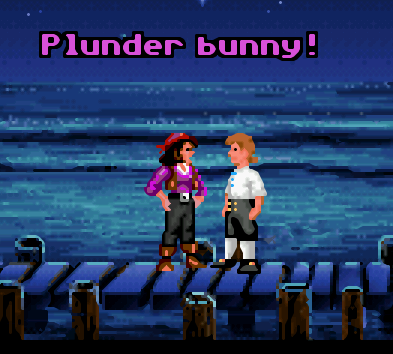
I very much enjoy playing games that are full of puzzles. I grew up as a point-and-click adventure gamer on the computer and used to spend hours playing King’s Quest V and the Monkey Island and Gabriel Knight games. I’ve moved almost exclusively from computer to console over the years, which means there are very few old school adventure options, although I have been getting back into some PC gaming for Telltale’s excellent take on Monkey Island and I’d also be lying if I said I didn’t enjoy Her Interactive’s Nancy Drew series. Yes, I realize I’m the wrong gender to play the latter, but I enjoy them nonetheless, plus I love the game designer’s old slogan: “For girls who aren’t afraid of a mouse.”

I guess this girl couldn't find her XBox controller.
Now, I know what you’re thinking. There are indeed puzzle games on consoles, although not usually of the point-and-click adventure style (which really works better with a keyboard-and-mouse setup anyway). This is true, but the bulk of my gaming these days takes place while I am exercising. I do step exercises and play the 360 while I step. It gives me time to play and—since I rarely get other time to game—helps motivate me to exercise. The problem is that I’m not smart or coordinated enough to play puzzle games while I work out. My stepping slows down and sometimes comes to a halt altogether while I’m trying to figure out how to complete a challenge or finish a level. I absolutely love both Portal games, but it’s difficult to play them while exercising so I had to squeeze them in at other times (like in the middle of the night, when my time is actually supposed to be set aside to write).

I have been *all* those characters. It just struck me
that this game might be a complex metaphor
for schizophrenia.
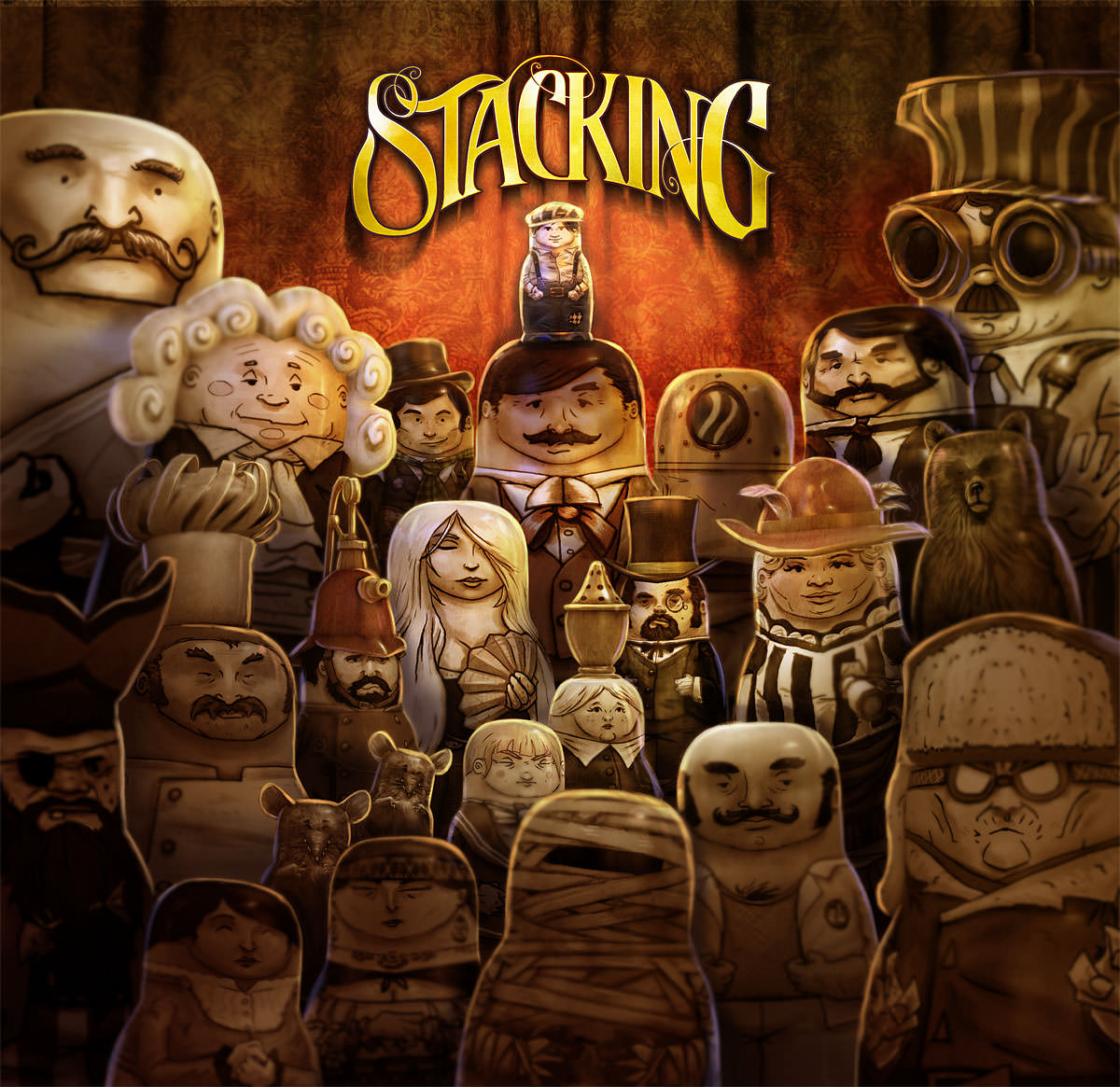
One very enjoyable console puzzle game that’s come out in recent years that I have found time to squeeze in is the Russian doll adventure puzzler Stacking. Although I could have done without the occasional bout of bathroom humor, I found the game to be pretty delightful. It has a completely unique gameplay dynamic. You play as a tiny little Russian stacking doll named Charlie. He’s so small that everyone underestimates him, but his tiny size gives him a unique ability: he can “stack” into other dolls, controlling them and solving puzzles through their different traits and attributes. There are five or six doll sizes, and Charlie can always stack into the next larger doll. So if he’s a size one, he can stack into any size two; as a size two, he can stack into any size three doll, and so on. Maybe he stacks into a doll who is goes around punching other dolls, or maybe he can clear a room by stacking into a doll with really bad gas. He can fly to certain places by stacking into a bird doll. No bird dolls around? Stack into a fish and flop about until you get one’s attention.

It’s charming, it’s funny and it’s full of interesting puzzles. One of the things I really like about the game is that each puzzle has multiple solutions. You’re encouraged to find them all. So maybe you clear that room by being Mr. Farty Pants on your first try, but then on the next try you can let such a draft into the room that everyone gets cold and leaves. Solving a puzzle one way is an achievement but it’s only the tip of the iceberg. You can only solve all the challenges by experimenting with different dolls and special activities, by deciding what each situation requires and fulfilling those requirements.

It might not be surprising that I thought several times while playing of Paul’s testimony that he became “all things to all people, that by all means I might save some” (1 Cor. 9:22). It’s probably not an unfamiliar passage, but is it one that is represented in our lives?

Just look at those little beady eyes. You just
know he's planning on reaching out to
people you don't care for. The nerve!
I know it’s controversial in some circles (particularly in certain circles in which people have nothing better to do than sit around and criticize other believers), but I agree with Rick Warren’s contention in The Purpose-Driven Life that we must deliberately and intentionally live our lives according to God’s purposes if we do not want to waste our time on this earth. Most video games thrive on purpose (with the notable exception of certain open world games that can be played a variety of ways) and Stacking is no different. Controlling Charlie Blackmore, we are compelled to figure out how to figure out each puzzle at least once to complete the story and finish the game. How much more do we need to have purpose in our lives?

Because that’s the first thing I see in Paul’s game plan. He has decided that one of his primary life purposes is going to be to reach the lost with the gospel message. Although those less ambitious might focus on a much smaller sample, Paul firmly has absolutely everyone in his sights. And he’s going to do whatever it takes to reach them. He is going to live his life in such a way so as to be the precise person that those lost souls need in their life. He is going to become like them—whether under the law, whether outside of the law, whether weak or poor, whatever—to build a relationship and encourage them to follow Jesus Christ.

Pop quiz time. I’m going to ask you a question and I want you to answer it immediately, without thinking. Okay. Ready? Here it goes: right now, who are you trying to reach for Christ?

I hope you didn’t think about it too much. That would have been cheating. There are countless different answers that might work there. Maybe it’s a small group like “my neighbors” or “my coworkers.” Maybe you’re passionate about reaching an ethnic or religious group (for instance, Muslims). Or maybe a name or two came immediately to mind, and you’re currently trying to reach Sydney or Lewis or Puddleglum. The only real wrong answer to the question, then—I mean, except for gibberish responses like “hexagon” or “the Oprah Winfrey Network”—is to stammer, to look away, to consider the question because you really don’t have an answer to it.

I may never be used to bring anyone into faith in Christ,
but I can sit in this pew like a boss, y'all.
If that describes you, then permit me to throw out this gentle little query: What in the world is the  matter with you? Huh, what is it? Christ’s blood not sufficient to save the people you know? Maybe you’re ashamed of the gospel of Christ? Or perhaps you’re a horrible old misanthrope simply puttering ever closer to the grave, hating everything and everyone. Regardless of the excuse, can you be so confident that the love of God is in you if you are so casually disobedient?

Those of you who answered my question promptly aren’t off the hook either. My next question goes back to Paul’s passion: how are you trying to reach the people you named? Are you, like Paul, doing everything possible to become all things to all people and save any that God permits you to save?

I could see the possible argument that Paul’s game plan here doesn’t sound very genuine. Authenticity is very important to me, and I think that the same goes for a lot of people. The idea of behaving a certain way only to achieve a goal—even a very noble goal like reaching someone with the gospel—seems phony. But loving people isn’t phony. Loving people who you don’t naturally love is difficult. It’s challenging. Ultimately, however, we love because of the very real love of Jesus Christ living inside of us, and there is nothing fake or phony in Him.

You called?
And maybe the Stacking analogy doesn’t fit all the way here because I don’t think we ought to change who we are for the explicit purpose of appealing to a certain group or person like some flip-flopping politician. I wouldn’t, for example, pretend to be a hunter just to share the gospel with hunters. For one thing, they would see right through me. But just because we don’t have that particular, bloody pastime in common doesn’t mean we have nothing in common. Maybe they, like me, enjoy musical theatre! I would like to go see Les Mis again while it’s still at the cinema. . . My point, of course, is that it’s worth the effort to find the common ground for the purpose of investing in one’s spiritual wellbeing.

But I think, for Paul, that it even went beyond that. I see in him the picture of a man who was so surrendered to God and His purposes that his greatest passion was for reaching the lost. If I were to define him with a phrase, it wouldn’t be as a tentmaker or even a preacher. It would be as a follower of Jesus Christ. What were Paul’s interests? Winning souls for Christ, no matter what it took. If that meant respectfully adhering to aspects of a Jewish law that Christ had freed him from, Paul was more than happy to do so because it gave him the chance to share the love of Jesus with someone who needed Him. That’s not who Paul was born, but through the power of the Holy Spirit, that’s who he became.

Someone's getting transformed!
Is it something we even desire? Would you pray to be so transformed? It sounds exhausting, honestly, to genuinely value making disciples over my hobbies and the things I do for relaxation (or even while I exercise). I know, intellectually, that the reason I am here is to point toward Christ, follow Him and make disciples. I know that I will get reward in heaven and should be about that mission with a singular focus. But the distractions are so darn distracting. We cannot afford to believe the lie that our task is anything other than urgent.

I see now that I have really misunderstood this passage. Paul’s not talking about changing who he is or how he acts to find more common ground with those who need Christ. He’s talking about the incredible work of transformation that the Holy Spirit has done in his heart so that reaching the lost is genuinely the most important task and the greatest joy of Paul’s life.

Paul strove to be everything to everyone because that’s who he had become. It wasn’t the least bit fake or phony because his greatest goals in life aligned with a lifestyle that was more than willing to adapt to put him closer to the lost. I said earlier that I can’t imagine what excuse a Christian could ever give if there is no one in their life that they are not actively trying to reach right now, and I stand by that. There’s no good excuse to not do what you were made for. But it’s not enough, is it? We need to be completely transformed. I need to be completely transformed. He has begun this work in me, I can tell, because I’ve come along way at trying to put the spiritual needs of others above whatever I think is important in the moment, but there’s still a long way to go. But I can’t fight it. We can’t fight it.

After all, this is what we’re here for.

Wednesday, December 26, 2012

A Dodgy Interview with Sophronia Belle Lyon, the Author of A Dodge, A Twist and a Tobacconist


I think this is Sophronia.
I must confess that I have been absolutely wretched at reading lately. I started reading Sophronia Belle Lyon’s inventive novel, A Dodge, A Twist and a Tobacconist, according to Goodreads, in late October and only just finished it on Christmas Eve. Please don’t take this to mean that I didn’t enjoy the book because I enjoyed it very much and I’m very happy to present here my interview with the author, Sophronia Belle Lyon.

Before we get to the interview, let me say a few words about the book. Ms. Lyon has gifted us with an exciting adventure that pairs beloved characters from Dickens, Alcott, Stevenson and more in a crime-fighting unit set in Victorian London with steampunk overtones. If you have no idea what in the world I’m rambling on about, let me assure you that A Dodge, A Twist and a Tobacconist may still be for you! I would hate for some potential readers to have doubts based on a word like steampunk, which may be unfamiliar, and pass up the rewarding and enjoyable experience of reading this book. It’s great fun to spend time with these familiar characters, but I believe that even readers unfamiliar with the original stories will get drawn in to the plot and the mystery contained within these pages.

The finest darn literary tribute
steampunk adventure I've ever
read in my life.
I didn’t love everything about the experience. My biggest quibble—and it really is nothing more than a quibble, one that might not even faze many readers—were fairly frequent “reports” given by some characters that the author uses as an excuse to present certain scenes with first person narration by secondary characters. These are not presented, however, as dialogue by the characters involved, but rather as narration indistinguishable from the first person narration provided by Florizel, the narrator. In dialogue, these different characters maintain distinct personalities (indeed, the diction is sometimes so heavy as to make some dialogue difficult to follow), so it’s a bit perplexing why these “reports” all sound the same. In the course of the story, these little detours are presented as reports delivered by certain characters to the rest of the crime-fighting team at the heart of the story; however, they took me out of the story since they read as traditional narration rather than the situation reports they claim to be. A character giving a report on a crime scene would probably not spend time describing extraneous details like a witness’ dress or eye color.

But that was, as I say, a pretty minor complaint. I thoroughly enjoyed the book and I recommend it whole-heartedly to readers who enjoy a variety of types of fiction. The inventions are fun, the characters memorable, the mystery engaging and the writing enjoyable. Additionally, A Dodge, A Twist and a Tobacconist is available in two forms: the standard version and a special illustrated edition full of vintage images and neat little Victorian touches. Both are perfectly affordable and both make a great read.

This interview wasn’t quite as straight-forward as others I have conducted, mostly due to the fact that the author lived and wrote in the late nineteenth century. I received an invitation to Sophronia’s “parlor for tea and mechanicals” via one of her descendants  Mary C. Findley. I should mention, by the way, that Mary is following in Sophronia’s footsteps as an author herself. She runs the Elk Jerky for the Soul blog with her husband (which also contains information about Sophronia’s books) and is the author of books including Chasing the Texas Wind, The Baron’s Ring and Benny and the Bank Robber. But I digress.

One of my best friends, and don't let anyone tell you otherwise.
As a good and proper American, I of course had no interest at all in tea and I had no idea what mechanicals were, but I enjoyed the book and figured it was worth the risk of having to drink tea to sit down with Sophronia and chat with her. The only problem was how to go back in time over a hundred years to take her up on her offer, a trip I usually only make on special occasions, or when entertaining royalty. I called my buddy Hermione but apparently a time turner wasn’t right for this mission, and those had all been conveniently destroyed in recent years so as not to become too big a plot hole. Then I happened to think of a solution more in line with the story at hand. A quick phone call and a trip to Surrey later and I had the most famous Time Machine in history at my disposal (well, after the Tardis).

I’m not sure precisely when I landed, but I was able to follow the quaint hand-drawn map Sophronia had provided to make my way to the meeting spot. I was admitted to her manor by a shimmering bronze automaton and shown into the parlor to wait for my hostess. “Wow,” I muttered to myself, looking around the parlor with its many inventive designs and clockwork machines. “Someone’s got a bit of a bronze fetish. . .”

Whenever I have questions about tea, this is the guy I call.
No sooner had I said these words than I heard a small cough and turned my head to see Sophronia Belle Lyon, the author of A Dodge, A Twist and a Tobacconist, coming to greet me. She offered me tea and what appeared to be scones. I may not be a tea drinker, but I definitely knew how to order it. “Tea,” I said. “Earl Grey. Hot.” This elicited nothing but a bizarre reaction from my host so I simply took what she offered. I sat down on a lavishly upholstered lounge chair that was fortunately one of the few items in the room not made of bronze. I set my scone down on its plate so I could fetch my recording device for the interview. I was about to pick it up again and take a bit when bronze legs sprouted from the sides and it scurried away from me. Well. . .she had invited me for tea and mechanicals after all. I shouldn’t have been surprised.
                                                                                    
Brad: Hello, Sophronia, and thank you for the invitation. Before we get started, I’m a bit turned around here. Would you mind telling me the date?

Sophronia: A young man never asks a lady the date, because it would be a clue to revealing her age, which he of course must never ask or seek to know. If you are asking the time period in which my series is set, which is, of course, contemporary fiction for me, the prologue of Florizel's years in Bohemia takes place in 188-- and the main story in 189--. Seek to know no more.

Brad: Fair enough. I’ll just have to see if I can pick up a newspaper on my way out. Let me say that I’ve never read a book quite like A Dodge, A Twist and a Tobacconist. I believe you’ve called it a “steampunk literary tribute novel.” Where did the idea come from?
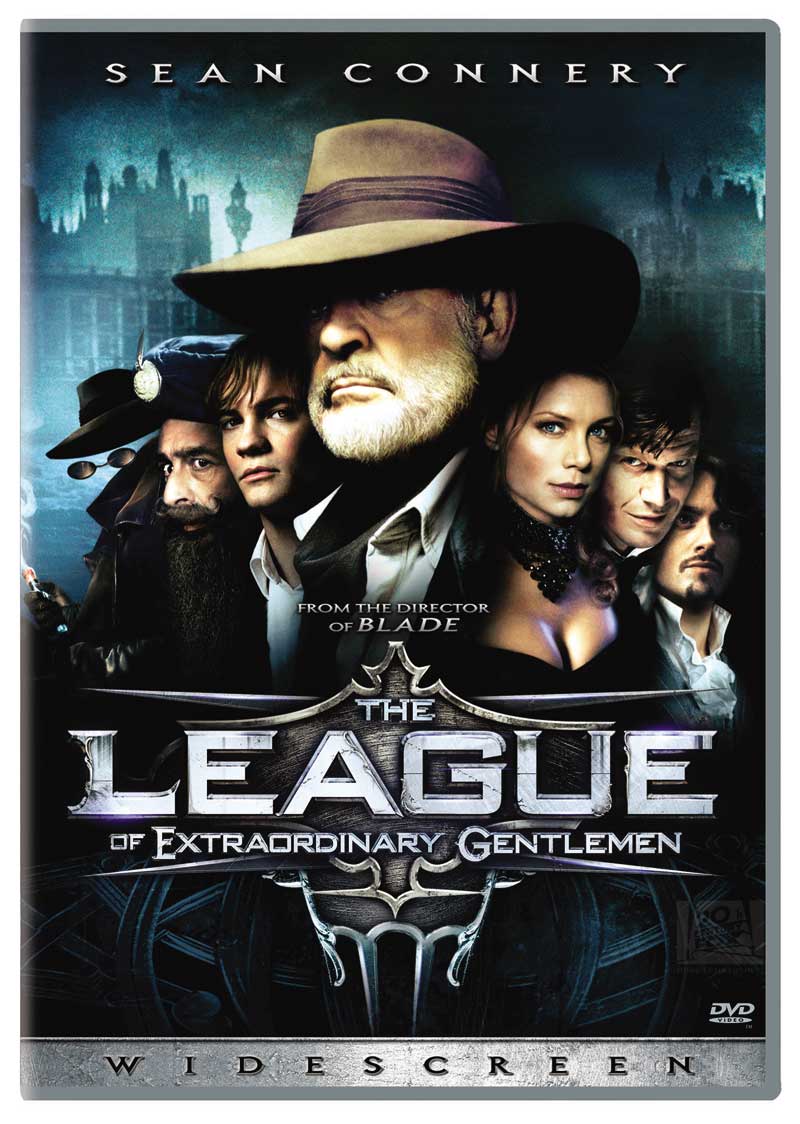
For your next Tawdry Movie Night.

Sophronia: There is a tawdry celluloid called The League of Extraordinary Gentlemen which was a great disappointment for me to view some years ago. It did considerable violence to the characters of some beloved classics, and so I set out to right a great wrong by creating my own Victorian era crime fighting league, with reverence and sensitivity for these people's true characters and natures. I also wanted to create mechanicals of my own to rival Verne and Welles.

Brad: Yes, you do certainly seem to enjoy mechanicals. But actually, before we go any farther, would you mind defining the whole steampunk genre or style or whatever it is for our less informed readers?

A visual representation of the word "steampunk."
Sophronia: I am learning more about this all the time myself. Steampunk is a type of Science Fiction, usually set in the Victorian era, 1800s to early 1900s, and relies on technologies based on steam and gearwork with a futuristic, speculative twist. (See how I worked that "Twist" in already?) 

Brad: Yes, I’m certain the pun was quite intentional. I’ll thank you to please dodge such obvious wordplay in the future. Your story contains characters from a number of classic works. Do you have a favorite character that you borrowed?

Sophronia: Phoebe Moore-Campbell (from Louisa May Alcott's Eight Cousins and Rose in Bloom) exemplifies for me what is best in womanhood. She uses her talents for God's glory, provides for her family through her abilities, spreads the Gospel, gives wise counsel, and provides leadership by bringing out the best of the abilities of each member of her Alexander Legacy Company. With all of this she manages to remain a devoted wife and mother. She also shoots a mean parasol-crossbow and her dresses are to die for!

I really meant the Batman villain, but when I searched for
"steampunk penguin," this is what came up and there
was no way I was going to leave it out of this blog.
Brad: Parasol crossbow, hm? Reminds me a bit of the Penguin. Are there any other characters that you were interested in including, but weren’t able to work in to this novel?

Sophronia: I wanted to include George Rouncewell, a character few have probably heard of, from Charles Dicken's Bleak House. He is a strong, simple, good man who thinks he's failed his family's hopes for him. His brother's a successful businessman and George runs a broken-down shooting gallery. George is an expert with firearms and a defender of the hopeless victims of the British court system. He may still find a place in the company down the road. It is a growing enterprise, having added two new members in the first book already!

Brad: Tell us about Florizel, your narrator and central protagonist. I’d be interested in knowing which character traits and attributes were found in Robert Louis Stevenson’s The Suicide Club, as well as how you may have altered or fleshed out the character.

Sophronia: Stevenson doesn't tell us a lot about Florizel. He makes him a bit more of an adventurer and devil-may-care type, and his mother and sister are barely mentioned as existing. Uncle Rudolfo and the conflict over republican values versus aristocracy are invented, as is Trevor Newsome, of course. I have given him a more solid and complimentary past because his courage, personal sacrifice, and determination deserve a tribute.

Brad: Although this is, ahem, a steampunk literary tribute novel, there are some very tender romantic moments. The small touches of love and affection between a number of the married couples felt as authentic and touching to me as anything in the book. Two new romances also bloom—although I hope any young readers take their romances much more slowly than the characters in the book! I’m interested in knowing if the female characters were introduce explicitly with the intention of hooking them up with certain single gentlemen, or if the romances developed more organically as the tale unfolded.
Pictured: Florizel and Visha's second date.

Sophronia: I really had no idea those silly people were going to go and fall in love like that. Visha Kanya (who I should mention is past the age of twenty, which is a good age for young ladies to first think of falling in love) was clearly smitten with Florizel's fearlessness and commanding presence the first time they met. His natural mention of God and His love for sinners deeply touched her. Oliver Twist had never even thought about the fair sex until he planted that theatrical kiss on Tatiana's cheek at Uncle Vanya's coffee shop. From that moment on, his nose was full of the scent of cinnamon and yeast and he was a lost man. Besides, Uncle Vanya would have done violence with his cast-iron rolling pin if Oliver hadn't done right by his daughter. A kiss is a seal, a pledge, that a true man must make good on.

Brad: And that is why I always avoid mistletoe. I kept thinking, when reading the book, that you seem particularly fond of Oliver Twist. His story and past become very important to the story, yes, but I also felt (real or imagined) a certain affection for the character through the descriptions and the like. I believe I’ve also read that Twist is also narrating the sequel. As a result—and I’ve no desire to give anything away so I’m trying to be very vague—I was shocked when something really vile befell the young inventor. Was it difficult to write about? Did you, as the author, have any emotional response to the pain you inflicted on this beloved character?

For more info on secular humanism,
Mary and her husband have literally
written the book on the subject.
Plus, it's illustrated!
Sophronia: I love Oliver. He's a social misfit like I am, and a scientist like many men in my life whom I love. But part of my purpose in writing this series, and everything I write, is to combat Secular Humanism. It is an ancient system of uprooting biblical principles and values and telling man he can be and do whatever he wishes, that nothing is right or wrong. What happens to Oliver Twist in the book teaches the lesson that man's quest for self-gratification and personal power leads to all manner of evil conduct. The enemy who attacks Oliver Twist represents the perversion of leadership, education, love and even friendship. It was very difficult to write about, and difficult to explain how even such a devastating thing can be overcome by God's power.

Brad: I do hope he continues to heal before the next installment. One of the major changes that you made to the majority of the characters is that virtually all the good guys are devout Christians. I have some hypothetical readers here—their names are hypothetically Larry and Carrie—who are pretty darn truculent at your (and I quote) “gall.” Although I never feel like us authors, creators of worlds that we are, are ever obligated to defend our work, I would like to give you the opportunity to make a response.

Mowgli sought Baloo after his conversion to share
the bare necessities of Christianity with him.
Sophronia: Larry and Carrie should remember that the undercurrent of true belief in God and high moral character runs through all the books by the authors who created my characters. Victorians, and even those earlier in the 1800s, like Austen, valued moral virtue, true examples of piety, generosity and care for the poor even f they weren't explicitly “Christian.” Your faith was your own business, held in a secret place and not spoken of, by Dickens and Austen and others. I chose to make it open, and to sweep a few "unbelievers" like Mowgli and probably Fun See, into the net of Christianity because it is my story, and I want people to know my Christ and His love for them.

Brad: Larry and Carrie have now hypothetically remembered that, as you suggested. Along the same lines, let’s talk for a moment about being a Christian author. Do you feel a responsibility to incorporate your faith into your writing? Do you just try to write the best stories you can, or do you have spiritual goals as well?

Sophronia: I always have spiritual goals. I want to see souls saved and growth in Christ occur. I want a foundation in the Word of God. These will always be in my stories, along with condemnation of wrong thinking and exaltation of truth. I might cloak them more deeply when I get around to writing the allegories I have in my head, but they will be there. 

Brad: Let me take this opportunity to apologize, Ma’am, for my subsequent actions. Your faith and sincerity make it even more difficult. You see, this shiny bronze umbrella that I have sitting in my lap is not merely an umbrella after all. It is actually a Barrett REC7 assault rifle disguised as an umbrella. It is, in fact, utter crap at keeping the rain off, but that’s beside the point. The point is that I am not a violent man, but I have found that the threat of deadly force is the most effective way of getting an author to name their favorite book. Oh, and let’s leave the Bible out of this, shall we? We are saved by grace, not works, Ms. Lyon, and the brownie points are not needed. Under the threat of untimely death, what is your answer?

It was the best of books,
it was the worst of books.
Sophronia: It is a good thing my collection of swords and knives is ready on the wall just behind me here, sir, and that I have a surprise or two hidden under my bustle as well, but I will answer out of courtesy and not fear. Charles Dickens' Tale of Two Cities is my favorite book, because Sidney Carton is the most amazing redemption story in all of literature: a brilliant but purposeless man prepared by love and personal sacrifice to abandon a life of drunken hopelessness and become a hero of epic proportions.

Brad: And your favorite author? Again, I apologize and I assure you that I feel dreadful, but I do owe certain answers to my inquisitive readers, and this is really the best way to procure this sort of information.

Sophronia: Charles Dickens. No one blends character, social concern, and suspense better.  

Brad: I’m a big fan of Dickens myself. Now, I would be remiss if I did not give you the opportunity to tell us what you’re working on currently. Please share!

If you judge books by their cover,
this one should already be
one of your favorites!
Sophronia: The ‘Pprentices, the Puppets, and the Pirate takes up the story of the Alexander Legacy Company from the point of view of Oliver Twist, as you have so cleverly discerned. We visit Nancy House, Oliver's training center for a new generation of mechanical geniuses. A sea monster will attack, Pinocchio will learn to obey a very different sort of Blue Fairy, and Long John Silver will risk his stealth air galleon, the Petite Papillion, in a quest for the energy source known as the Black Spot. Along the way there will be lessons about the nature of true rebirth and immortality.

Brad: Sounds very interesting, and I can honestly say that I’m looking very much forward to reading it.  I’ve got one last question. You are a self-published, independent author, Ms. Lyon. Aside from purchasing your books, how can  readers who enjoy your work best support you and other indie authors?

Sophronia: Keep an open mind and dig for your reading choices by the subjects you love, not just someone who made bestseller lists or has a famous name or a major publishing house. Be willing to take some time to search for books in your favorite genre and even outside your “comfort zone.” I have been so privileged, since I am a reader as well as a writer, to get to know many indie authors online and to hear about their books. I've read and enjoyed fantasy, sci-fi, paranormal, historical, and even (shudder) contemporary romance. :-)

Our interview thus concluded, I thanked Sophronia for her time. She started asking questions about Mary and things in the future, but I politely declined to answer her, since we all know how this would have affected the space-time continuum. I did assure her that A Dodge, A Twist and a Tobacconist was a runaway bestseller, however, and that it had already been picked up for a film adaptation starring Nicolas Cage. She accepted this without surprise, even though I was more or less exaggerating. I didn’t quite have the heart to tell her that her book, enjoyable as it is, was unlikely to achieve the popularity of sparkly vampire fanfic featuring excessive amounts of S&M sex and wooden writing. I didn’t think she would much appreciate this preview of the world to come.
"Hi."
"Hi!"

"Yo."
I’m afraid that I cannot quite reveal the extent of my adventures before returning the machine to the Time Traveller. I may have taken her around the block once or twice. Suffice it to say that Marty McFly says hi. And so does Martha Jones. And George Carlin. And Jadzia Dax. One who traverses the bounds of time and space is in good company, you know.

"Hello, Sailor!"
And if that makes you want to have adventures of your own, one of the best suggestions I can make is to pick up your own copy of Sophronia’s book and dig in yourself.

Tuesday, December 18, 2012

A Drunk Demon and His Revival


If you stopped by a week ago, welcome back! If you’ve never been here before, welcome for the first time! If you swing by regularly because that’s how you roll, then hey it’s great to see you again and we greatly appreciate your patronage.

This is what Mary's working on.
I love the cover so much and am
enjoying the first book in the series
so much that I'm plugging it here!
I’ve been excited about today ever since I learned about The Next Big Thing blog theme promotion thing from fellow indie author Mary C. Findley over at her ElkJerky For the Soul blog. I’ve been working on my current novel for a while now and I can see where it is all beginning to wrap up in the next several chapters, so that meant that it was going to be time to officially announce the book soon and this blog theme promotion thing seemed like the perfect opportunity! Stick around at the end of the post for a link to some other bloggers who will also be taking this opportunity to discuss their latest works as part of the same blog theme promotion thing! Oh, for what it’s worth, I sort of reordered some of the questions in the prompt so that they made more sense to me.

The Next Big Thing

Title: The Savvy Demon’s Guide to Godly Living

Genre: Adult Christian fiction. I know that’s vague. You could add “Contemporary” to it, if you’d like.

Agency Representation: Indie, baby! I’m self-published.

Doing a Google Images search for "drunk
demon" returns interesting results.
Short Synopsis: Our story begins with a demon named Melchior. He’s fed up with his job because the church he’s assigned to distract and tempt and torment never do anything for the Kingdom of God anyway, so he’s bored out of his mind. To alleviate this boredom, he gets drunk off his bum. While venting to a fellow barfly, he gets the idea that the best way to really stick it to the boss—and maybe even end the boredom—is to go pay the church’s pastor a visit and tell him precisely how badly their screwing up. The early morning chat with the inebriated demon absolutely changes the pastor’s life. He becomes convicted and determines to truly follow Christ and be faithful in making disciples. A small group of believers joins him in his goal and New Jersey is never going to be the same again.

Where did the idea come from? Direct from the Holy Spirit. The idea came so suddenly and dramatically that I credit God one hundred percent as my inspiration. Please understand that I’m not trying to be arrogant or say that my book is above criticism. Inspiration is very personal and I credit God with all my ideas, but this one felt specially delivered (as did my short story, TheBook of the Harvest, incidentally).

If you ever wonder why I
don't write romance, it's
because this is what my
characters look like.
I'm sorry you died before
the movie deal, Denise.
What actors would play your character in a movie version? The book features an ensemble of at least half a dozen main characters. but I’ll focus on just a couple. I would like to cast Paul Giamatti as the pastor, Doug Pinkerton. His wife, Joan. . .well, I’m having a bit of a difficult time finding an actress of the appropriate girth for the role. I was going to suggest Denise Borino-Quinn, whose only credit is as Ginny Sacrimoni, a mob boss’ wife in The Sopranos, but, alas, she died in 2010. Well, it’s certainly not going to be Rosie O’Donnell. I can tell you that right now.

How long did it take to write the first draft? Not quite done yet, although I begin to see the end in sight. I don’t know precisely when I started, but it looks like it was in May 2012. There have been some bumps along the road, but the words have usually flowed forth pretty steadily.

If this book starts any massive Christian merchandising
crazes, you have my permission to buy copies and burn them.
What other books in the genre compare? I have never read a book like this. Thematically, about a group of believers who decide to stop playing around with mainstream Christianity and actually start following Christ, Charles Sheldon’s classic novel In His Steps comes to mind. When it comes to tone and the actual story, however, Savvy Demon’s Guide is dramatically different.

Any other in this genre? Boy, this question is difficult to figure out. I saw that Mary, on her blog, took this to ask whether she had written any other in the genre, so I’ll go with that too. My short story, The Book of the Harvest, is also best classified as Adult Christian Fiction, I suppose. My published catalogue is pretty limited at this point, though, so my only other available novel falls under Christian Fantasy.

Who or what inspired this WIP? The only direct influence that I can identify is Oliver Twist by Charles Dickens, and the influence here is in the narration and tone of the book. The Narrator for Oliver Twist is extremely sarcastic and very funny (but I appreciate a lot of Dickens’ humor). I tried to follow his example in the Narrator for Savvy Demon’s Guide. Otherwise, I would say that, as a believer trying to follow Christ, my own journey certainly had a big influence on the book, but I’m sure that would be the case for anything I’ve written.

Drug addiction is not funny, but anything
that brings a sinner to their knees, crying
out for the mercy of their Savior, can be
used for God's glory.
Anything to add? I’m extremely excited about this book, as well as a bit apprehensive. This is a dramatic departure from my previous novel, Emaline’s Gift, and I’m not sure how the fans of that book will appreciate this one. For one thing, this is definitely intended for a more mature audience. I think it’s a more mature work, but also contains some vulgar language and situations. There is actually a fair amount of profanity in the book, but it’s censored in a way that I feel fits with the seriocomic tone. Some of the characters make very bad decisions and the book does not shy away from it. This is a story about sinners who are forgiven much and love much. There’s a great deal of moral darkness—but I believe the redeeming light of Jesus Christ shines much brighter, and the way He works is all the more exciting because of the darkness.

In the end, I’m proud to put my name on the cover. I believe this will challenge and encourage believers, even as I’m sure it may offend some as well. It’s not my intention to be offensive, but I’ve come to peace with that. I believe this is a story God wanted me to tell, and ultimately I answer to Him. Oh, but I’ve also started the second book in The Magi Chronicles and intend to go back to work on that as soon as I’m done with the first draft on this one!

Thanks, everyone, for coming by and seeing what’s been rolling about in my brain. I hope you’ll give Savvy Demon’s Guide a chance when it releases in 2013, and I think you’ll be rewarded if you do so. Now, I was supposed to find five other authors who blog and rope them into this blog theme promotion thing as well. I failed. But I found two!

So I encourage you to swing by and visit:

Cynthia P. Willow, who also writes Christian fantasy, including Patty Gayle and the Legend of Kingsley. She’s also the author of Hell’s Christmas. (Oh, and by the way, I’ll be hosting an interview with Cynthia right here on this blog at some point!)

Amy Magaw, the author of Wheels of Love and Home, which are both part of the Breaking Dawn series.

Go ahead and visit these ladies now if you’d like and learn more about them. Their Next Big Thing blog posts—where we get to hear about their new writing projects—should go live in a week, on December 26. I know it’s weird that I’m linking to them now and saying they’ll be doing this in a week, but consider it pre-anticipation. Yeah, that’s it.

Are you pre-excited yet?

Sunday, December 16, 2012

You Make Me Want to Watch a Better Movie

Needs a box for "Um, I sent me Son to DIE for you, didn't I?"

I was lying in bed, just sort of talking to God. Actually, I initiated one of those “state of the relationship” sort of chats. It really comes down to love, right?

Do You love me? I asked, but I wasn’t really asking. I knew the answer, because it’s been proven to me countless times. Yes, of course You love me, I answered myself. You love me a great deal. I actually lay there in the dark, looking up at the ceiling and grinning like a schoolgirl, I am not ashamed to admit. Thinking about my Savior’s love for me has that effect. It’s so wonderful, so strong, so steadfast and so completely undeniable. You could never make me doubt His love. Taylor Swift would sooner get back together with that one guy than I would doubt the love of my Savior and my God.

Well, since His devotion was not remotely in doubt, I turned my thoughts to me. I know I love You, I thought, and I meant it. Human love is so different, at least in my experience, to the love shared between a disciple and One he cannot see or feel or touch, at least in tangible ways. There was a time when I don’t suppose I knew much what it meant to really love God. I don’t think I could give you a great dictionary definition now, but a thought did come to mind.

Inhibiting Helen Hunt's
career since 1992.
“You make me want to be a better man.”

If you love movies about natural
disasters, you'll LOVE this film
about an misanthrope who's very mean.
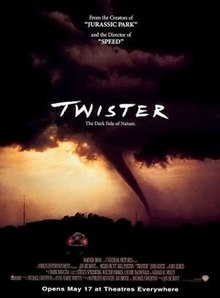
That was the thought, and it’s a stolen one. You might recognize it from a movie that came out many moons ago (the Nineties, I believe) called As Good As It Gets. It was made at a magical time when someone thought that Helen Hunt might be a bona fide movie star if you could just get her away from Paul Reiser. Everyone really liked this movie, as I recall, although I didn’t think much of it when I finally saw it. Since I only saw the film once and thought it thoroughly meh, I’m trying to figure out why I’m so familiar with that quote. I believe that there may have been a trailer for the movie on a VHS movie that we owned, maybe Twister or something, and that may explain why that bit is so ingrained in my consciousness.

Quick! Name a Jack Nicholson movie from the past
twenty years where he does NOT play a grumpy old man.
Go ahead. We'll wait.
But back to the quote: “You make me want to be a better man.” Now, let me go and ahead offer the disclaimer that I may not have that quote down word-for-word. I don’t need any Jack Nicholson aficionados complaining in the comments section. But I think I got the essence right, anyway. I’m sure there were plenty of female viewers fluttering their eyelids and swooning at the thought of a grumpy old misanthrope striving to be a less grumpy old misanthrope for the sake of some blonde lady who might be a waitress, I think (I don’t recall). Without doubt, changing oneself to get other people to like you better is a popular concept, and is pretty much the entire message behind Grease. But it takes on a whole different element when it comes to our relationship with God.

I know that God loves me the way I am. I also know that He loves me too much to let me stay that way (is that a cliché? ah, well. . .). In MereChristianity, CS Lewis describes the changes that the God makes in the life of the redeemed:

“Imagine yourself as a living house. God comes in to rebuild that house. At first, perhaps, you can understand what He is doing. He is getting the drains right and stopping the leaks in the roof and so on; you knew that those jobs needed doing and so you are not surprised. But presently He starts knocking the house about in a way that hurts abominably and does not seem to make any sense. What on earth is He up to? The explanation is that He is building quite a different house from the one you thought of - throwing out a new wing here, putting on an extra floor there, running up towers, making courtyards. You thought you were being made into a decent little cottage: but He is building a palace. He intends to come and live in it Himself.”

I think that sometimes were tempted to think that these necessary changes are arbitrary, that they serve only the purpose of molding us into some sort of godly ideal, perhaps to make us fit for an eternity in heaven. I don’t believe that’s the case at all. Rather, I think that the process of transformation that makes us more Christlike is extremely practical. For one thing, take a look at the pain and sorrow in your life and try to figure out how much of it is the result of sinful behavior. Certainly, some pain—disease, accident, natural disaster—comes simply from living in this fallen world, but a great deal of suffering is also self-inflicted (the result of our own sin) and inflicted by others (the result of their sin). This devastating tragedy in Connecticut that has so rocked our nation was without doubt the result of sin. Sin has consequences. God gives us a plan not just for godly living but also for wise living. To follow His path is to escape many of the painful consequences of sin, although of course following in the steps of the Man of Sorrows Himself will not grant us a life free from all pain.

But living a Christlike life can also have a profound impact in the lives of others. Jesus listed the two most important commandments as loving God with all that you are and loving others as yourself (Matt. 22:37-40). Ultimately, to become more like Jesus is to be more filled with love for our Lord and for other people. In his book UnChristian, Barna Group president  David Kinnaman says that Christians “have become famous for what we oppose, rather than who we are for.” It’s true. In the New Testament, Christians were known for their association with Jesus Christ. In fact, when Paul was put on trial, he declared that the reason for the charges were because he believed in the resurrection of the dead (Acts 24:21), specifically because he taught the resurrection of one individual: Jesus. In fact, the very title Christians was all about Jesus. The believers were believers because they followed Christ and everyone knew it.

Now, I would argue that the term Christian has lost much of its original meaning. Most people associate the term with, just like Kinnaman says, with what Christians are opposed to. They’re anti-gay marriage, anti-abortion, anti-Democrat, anti-immorality and so on. Contrast this with Jesus words to His disciples: “By this will all people know that you are my disciples, if you have love for one another” (John 13:35). Notice that He didn’t say that love was how people would recognize Christians. He said that this is how the world would be able to recognize His disciples. Through love.

Godly living and a tasty fruit salad.
See, if I permit the Holy Spirit to transform me into a better man, what this means practically is that I will love more. You will be able to tell that I follow Christ not through how I vote or where I picket or how loudly I complain, but through a life that is categorized by sacrificial love. I will not be known by who I hate. I will not be known for what I am against. I will be known by the fact that I love the lost and strive to share the love of Jesus Christ with them. Look at the fruit of the Spirit, for example: love, joy, peace, patience, kindness, goodness, gentleness, faithful and self-control (Gal. 5:22-23). These aren’t vague, ooey-gooey feelings or something. This is a description of how we are to treat other people. And just maybe they’ll see His light in us and glorify our Father in heaven (Mat. 5:16).

Dear Father, I am a selfish person by nature. I’m not saying that I’m always only looking out for myself, but that is surely what I default to. But You make me want to be a better man. You make me want to live a godly life that shines before others that You can use to draw them to Your arms. I know that is it Your influence in my heart that makes me even want these things. Help me, Father. Help me to live the sort of life that will impact others and draw them in. Help me to love the unlovable because of Your great love for me. Help me, Lord, to be a better man—because I surely can’t do it without you. And neither can Jack Nicholson. Amen.