Wednesday, March 6, 2013

Following the Leader, the Leader, the Leader...

Next fall on Fox they'll greenlight the spinoff: The Leadinging.

Please note: this post takes inspiration from the Fox television show The Following, but it spoils absolutely nothing. Except for your milk. I’m sorry to tell you, but you’ll need to pick up another gallon on your way home from work. Or you could just have Emaline get it.

Please also note: The previous paragraph contained a reference to the book Emaline’s Gift. If you have not read Emaline’s Gift, the reference will make no sense to you. The only possible solution I can think of is to go buy it, read it immediately, come back, reread that first paragraph, understand the reference and then go on with your regularly scheduled life. If you can think of another solution, I’m sure it’s not nearly as good.

You might even say he's "following" her lead!
Oh and note this too: Actually, I’ve got nothing else to say. I was just wondering how many of these addendums I could get away with.

So Kevin Bacon decided to take a page from his wife’s book and do a TV show (Kyra Sedgwick, of course, played Brenda Leigh Johnson for seven seasons of The Closer on TNT). I’m glad he did, because his performance, in my opinion, is one of the best things about The Following, and I enjoy the show a great deal. I’ll admit that the series is pretty divisive. It can be pretty grisly, for one thing, and it certainly requires a certain suspension of belief (as many shows do) so it’s really up to the viewer whether they can still go with it and have a good time or not. The wife and I enjoy it, but it’s certainly not everyone’s cup of tea.

The cartoon that changed Joe Carroll's life.
That’s fine, of course, because we have a greater purpose to discuss anyway. The central premise of the show centers around a serial killer who was captured years ago (by Bacon’s character, Ryan Hardy). The killer, Joe Carroll, is arrogant, pretentious and obsessed with Edgar Allen Poe. I know what you’re thinking. If he’s so full of himself, why did he choose to be obsessed with such a writer whose creepiness has become such a cliché? Wouldn’t someone a bit more obscure fit the character a bit better? I mean, The Raven was covered by Tiny Toons! If that doesn’t make it lose a bit of street cred, what does? I think I’ve gotten a bit off track.

The idea is that Carroll is such a charismatic individual that he has amassed a group of loyal followers. While he is locked up in prison, grinning his smug little grin, his followers are out killing and causing all sorts of bloody mischief. Carroll is pulling the strings, of course, but his deluded disciples are so passionate about their leader that they are risking imprisonment or even death by carrying out his wishes. The idea must have been somewhat inspired by the Manson Family and others like them. Their association certainly reaches to some religious fervor, to the point where Carroll’s followers are dubbed “a cult.”
               
SERIAL KILLERS: DO NOT
READ THIS BOOK.
Whereas I’m not a huge fan of all the murder and kidnapping and the like, I’ve got to admire the loyalty and the dedication of these followers. They have essentially been willing to give up or change everything in their lives to do what Carroll tells them to do. Can you even imagine that sort of devotion? What would it take? I’m reminded of a quote by researcher extraordinaire George Barna who said in his book Growing True Disciples, “The twenty-first-century church has many ‘followers’ of Christ in the sense that I follow the Yankees: We dabble in Christianity.”

Now think about it. Think about the devotion that we see in obsessive cultists like those on The Following or the type that drank the Kool-aid that Jim Jones served or even the suicide bombers who give it all for the sake of jihad. If our devotion to Christ is anything less, is it because He expects less from us—or because we’re not giving all we should? Are we less committed to the Truth of Christ than some people are to the lies that they follow? Do we follow Jesus Christ, giving all up in His pursuit, or do we “follow” Him the way we follow a sports team, tuning in to give them half our attention once a week, getting caught up in victories and defeats on some shallow, emotional level, but without any of it really affecting our lives?

SERIAL KILLERS: THIS ONE IS SAFE.
GO AHEAD AND ENJOY!
And, yes, I do realize that there are people who follow sports teams obsessively. Trust me, you don’t want to mention baseball to my sisters any time within the few days following the Yankees’ annual ousting from the playoffs. Would that they would follow Christ even to that degree.

What does Jesus really expect from us? Based on various passages of Scripture, we can come to the conclusion that followers of Jesus Christ: must deny themselves, pick up their cross daily and follow Him (Luke 9:23); love Christ so much that it looks like they hate their family and their own life by comparison (Luke 14:26); renounce all that they own (Luke 14:33)—and I could go on, but I think we’ve already got a clear picture, haven’t we? Christ doesn’t call for dabblers. He calls for full-on fanatics, zealots who will put Him and His mission above everything and everyone. To follow Christ is to no longer live for yourself. It’s to live for Him.

But it’s very easy to get distracted, isn’t it? In The Following, we are introduced early on in the series to a core group of three of his followers who literally let their entire lives be dictated by the needs of their leader. Two straight men posed as lovers because gay neighbors would be the least threatening to a woman who had been assaulted in the past. A young woman becomes a qualified nanny and works for years in that environment until it is time to act. Talk about devotion. Their lives are not their own, by choice.
Anyway, the guy with the gun probably has
more verses memorized than you do.
And the Second Amendment.

So, yes, I know that you and I are willing to die for our faith, if the situation were to ever arise. Perhaps we might doubt that a bit, but the truth is that we may never find out for sure. Most Christians in the United States, at least in modern times, never have to make that decision. Quite frankly, it’s easy to make the commitment to be true to Christ even if it meant your life when it’s something that has a pretty slim chance of ever happening.

And you don't even NEED kidneys to
tell people about Jesus! That's the crazy part!
Let’s talk, then, not about slim possibilities but about reality. You may or may not be presented with the opportunity to give your life for your faith someday, but you very much have the opportunity to live for it—for Him—right now. Part of that is just in putting Him first in our day-to-day lives. The reality is that we pass people with needs—physical, emotional, whatever—on a daily basis and I firmly believe that every need is an opportunity to help someone in the name of Jesus. Why would you ever drive by someone broken down by the side of the road, when by stopping and giving them a ride to the gas station or putting some money in their tank could present an opportunity to share the Gospel with them? Sometimes the Holy Spirit opens that door and sometimes He doesn’t, but there is always the opportunity to help someone out and, when they thank you, simply telling them that you’re a follower of Jesus Christ and you’re helping out because it’s one way that you can show His love to others. Even that plants a seed, and sometimes it can lead to a lot more. And what if the person by the side of the road is some nefarious criminal, looking to steal your car and sell your kidneys? Well, we just talked about the fact that we put Christ before our own lives, didn’t we? He will protect us or He won’t; blessed be the name of the Lord.

That’s just one example, of course; the truth is that there are countless little ways to serve others in the name of Christ. There tends to be a cost. Sometimes the cost is financial and serving others will almost always cost time. Now, if the money is all God’s and if every moment you are alive is a gift from Him, is being selfish with our time and money ever the right move?

Pictured: actual fictional inner city
Baltimore classroom.
I feel like we need to really evaluate and find out if we are following Jesus to the best of our ability where we’re at, wherever we’re at. But here’s another question that the serial killer’s followers on the TV show asked that we may not: Are you in a place where you can have the maximum impact for the Kingdom of God? Geographically? Vocationally?

Could you have greater impact as a follower of Jesus Christ as a youth pastor in rural Indiana or as a high school teacher in inner city Baltimore? Could you reach more lost souls with the Gospel working as a receptionist at a Pennsylvania paper company or as a bartender at a hotel by the airport? Do you suppose that you do more good at your well-paying job in your comfortable home sending $30 to WorldVision each month, or could God use you better halfway across the world, living and working in the communities ravaged by AIDS and desperate for clean water? 

It’s just a thought, and I don’t believe there is one blanket answer for everybody, but I simply want to know whether or not you’ve asked the question. Have you ever honestly prayed, Father, my life is yours. I will move my family anywhere you say. I will get a job wherever you open doors. I want my life to have maximum impact for You so please put me wherever I can best serve you.

We are here to reach others for Jesus Christ. We are here to be salt and light. Everything else is just sound and fury, signifying nothing.

So back to those kooky serial killerettes who were willing to alter their entire lives for their leader. What could ever drive someone to those extremes? Love, devotion and belief. I don’t have to ask how much they love their leader. I don’t have to ask if they’re devoted. It would be silly to ask whether they truly believe in what he’s selling, because they have proven where they stand.

It's possible I got the wrong "judgment day."
This isn’t about proving something, not to me, not to God, not to anyone. This is about impact. This is about using everything we have to glorify the One we follow. When you’re standing in front of God someday, giving an account for how you used your gifts, talents and resources for His purposes, are you going to regret how you spent today? Tomorrow? This year? In that instant, when everything is so clear and billions have been sentenced to hell and it’s too late to make a difference, are you going to wish you had done things differently?

My advice: don’t wait. Take stock. Pray. If you need to make a change, make it. When this life is over, you won’t regret it.

Thursday, February 7, 2013

The Evolution of Jean Valjean


Permit me to begin this post by apologizing for being such an infrequent blogger lately. Oh, I know I’m never all that consistent at the best of times, but I’ve been really slow lately since entering into my final semester of seminary three or four weeks ago. There’s a great deal of schoolwork piling up, but I’m trying to deliberately schedule times to do a little blogging each week, so we’ll see how that goes. And in May, God willing, I will have graduated with a Master of Arts in Discipleship Ministries from Liberty Baptist Theological Seminary. So yay!

When it comes to theofictionology—my little gibberish term to refer to the mining of fictional works for spiritual truths that we like to do around here—this post was always going to be so easy that it could write itself. We’re turning our attention today to Les Misérables, specifically the recent film adaptation of the 1980 musical directed by Tom Hooper. I’ve never read the book, but I suppose my daughter and I will read it together before long.

Seriously. Francis Chan couldn't
unearth spiritual themes in this rubbish.
Let me be very forthcoming by outing myself as a fan of musical theatre. Yes, I’m a heterosexual man who greatly enjoys the theatre, including musicals. My undergrad degree is in theatre (specializing in acting and playwriting), I absolutely love performing on stage and oh how I wish I had the ability to sing well enough to perform in musicals, so long as they are written by someone other than Andrew Lloyd Webber. Gosh, I despise Webber’s stuff. So you probably won’t see theofictionology posts here about Cats or Phantom of the Opera. I doubt we could find anything terribly godly in something like Jesus Christ Superstar anyway.

But I digress. I love musicals and I think I’ve seen Les Mis on stage more than anything else (with the exception of Beauty and the Beast, and only that if we count some truly awful children’s theatre performances—like, the kind that suddenly interrupt the show in the middle of the climax for unfunny banter by insipid characters created by the local director; you know the type). I was looking forward to this film so hard and the first teaser trailer featuring Anne Hathaway’s brilliant performance of I Dreamed a Dream made its Christmas Day release date ever so far away. But then some other clips of the film were made available, brief bits without context (although I was familiar with the story of course) that made me very, very worried. Especially Russell Crowe. He’s a fine actor and he looks pretty much how I expect Javert to look but the clips of his singing left a whole heck of a lot to be desired.
This hat is totally anachronistic but it includes an autotuner.

I was nervous, yeah, but there was no way I was going to miss seeing Les Mis. Christmas Day came and I was going to go online and buy tickets in advance, but there was that pesky service fee and the online system indicated there were plenty of seats available and so I didn’t and, well, that’s why we saw The Hobbit on Christmas. My wife still won’t talk to me. But the good news is that we did eventually see Les Mis in the cinema and it absolutely blew me away. Yes, Russell Crowe didn’t have the slightest business being cast and the movie would have been even better with a Javert who could sing and act at the same time, but the rest of the cast was so excellent, the story so incredible and the whole affair so heartbreaking and emotional that even he couldn’t ruin it for me. I know that the film’s pretty divisive, and that’s fine if you don’t like it, but it captured me and did not let me go. Hooper created a unique experience even from seeing it on stage and I thought it worked like crazy. Remarkable. I wanted to go see it again but, y’know, childcare and all that.

The reason that this blog post more or less writes itself, however, is the fact that Les Mis is, at its heart, a story of redemption. Oh, there are a great number of themes and I could point out many of them to amplify and focus on here, but the central journey, both physical and spiritual, of Jean Valjean resonates greater than all the rest.

Of course, since the bread was from Jimmy John's,
the theft carried harsher penalties than if it were a lesser loaf.
Under the strict laws of the French penal system, Valjean spends nineteen long years in hard labor for stealing a loaf of bread to save his starving nephew. Upon his release, he seeks to put his life back together but, as a convict, he’s not paid the same wage as other men for the same work and inns won’t allow him to enter and stay. A godly Bishop, however, takes pity on him and gives him a place to stay. Bitter and angry at the world in which he lives, Valjean waits until the Bishop is asleep before stealing silver and taking off in the middle of the night. He is promptly apprehended and tells the police that the silver was a gift. They scoff at him, of course, and drag him back to the Bishop to learn the truth. Much to Valjean’s shock, the Bishop not only confirms his story but gives him two valuable silver candlesticks in addition to the rest. When the police leave, the Bishop makes it clear to Valjean that his gift is given with purpose: Valjean is to take these precious metals and use the money to become an honest man. “I have bought your soul for God,” he tells him.
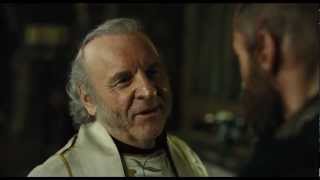
The Bishop look familiar? He should! It's the
REAL Valjean! Like, from Broadway and the West End!

This act of Christian kindness and generosity changes Valjean. Well, let me rephrase that. The Holy Spirit uses the Bishop’s generosity to change Jean Valjean. Oh, no one explicitly says (or sings) that but was there really that many musical numbers when it happened for you? For the rest of his life, Valjean lives in a manner consistent with being granted salvation that day. He is not perfect and he doesn’t always do the right thing, but the rest of the movie shows a man changed to the core. It’s a tale of redemption. The old has passed away and the new has come and there is evidence of that in every frame.

Valjean breaks his parole. Remember that he was just a baby Christian at this point. Years later, God has blessed him and he is a fair and generous employer and even the mayor of a town called Montreuil-sur-Mer. The man who stole from a priest is now fair, hardworking and providing a better life for others. It’s not long before he encounters Inspector Javert, who worked at the prison where Valjean served his time. Javert thinks he recognizes the old inmate, still technically a fugitive from justice, but his suspicions are proved incorrect when he announces that Valjean has been captured. The real Valjean is torn about what to do, but he knows he cannot allow an innocent man to be punished for his crimes. Prepared to throw everything away in the name of justice, he reveals his true identity to Javert so that they will release their prisoner and take him instead.

Did I mention that the ladies go crazy for transformation?
Well, the introverted bookworm girl next door type do.
Witness the remarkable change in the man. I would suggest that such a powerful change is not possible without the awesome transformative power of the Holy Spirit. Valjean decided it was more important to be right with God than to remain free.

You see, it’s impossible to be an undercover follower of Jesus Christ. I’m not saying you need to have an ichthus on your car, but the Bible is extremely clear on the fact that saving faith has very real, practical consequences in one’s life. We are saved for the purpose of doing good works (Eph. 2:10); what’s more, so-called faith without deeds is dead and cannot save (James 2:14-17). No amount of good works can get anybody into heaven, but a Christ follower whose life does not bear the fruit of good works is not a Christ follower at all (John 15:4-6).

The fruit of Valjean’s changed heart and life is in evidence throughout the film. He rescues a child and raises her as his own after the death of her mother (why in the world are there still so many orphans without a family in our nation and our world, by the way, when you cannot possibly flip through the pages of Scripture without seeing God’s heart for the fatherless?). We see him giving to the poor and needy, both money and human contact, seeing to their physical and emotional needs. We see how selfless he has become, when even his instincts for preservation are overridden by his love for others. Before being drawn to Christ, shortly after his release from prison, Valjean had emphatically stated that he would never forgive those who had imprisoned him for so long. Of course, as believers, we don’t forgive because anyone deserves to be forgiven, but rather because Christ forgave us (Eph. 4:32). Forgiveness is a powerful act (and a theme, incidentally, that has woven its way into my new book, The Savvy Demon’s Guide to Godly Living, countless times), and there can be no doubt that Jean Valjean is a changed man because of whom he forgives.
"Now that I don't have all that hair
holding me back, I can totally
concentrate on acting."

I love Les Misérables for many reasons. I love the songs (you might even remember an episode of Seinfeld about how catchy some of the songs are). I love the raw, powerful performances in the film (seriously, Anne Hathaway was SO good). I love the epic story and the incredible spectacle on stage (and on film) But what I may love most of all is the incredible story of redemption.

If you’re a follower of Jesus Christ, you have your own redemption story. I have mine. They may or may not be as dramatic as that of Jean Valjean, but I believe there will always be sheer power in the story of a man or woman transformed by the Holy Spirit. Look at the way following Christ has changed you. Look at the other lives you’ve touched, the people you’ve served, the disciples you’ve made. Can you trace the progression from selfish to selfless (allowing, of course, that we are works in progress who will not be finish this side of heaven)? I feel like there are few more persuasive arguments for the reality of a living, loving God than our living, breathing stories of redemption. God is in the business of changing lives. Can you believe that there’s a major Hollywood film about it?

Wrong Tony.
I’d love to hear some of your redemption story in the comments below. If it’s particularly compelling, you might even think of sending it off to Schönberg and Boublil, the fellows who originally adapted Les Mis for the stage. They couldn’t certainly use another hit and, who knows, maybe there’ll be a Tony in your future? Whether your story is destined for the Broadway stage or not, nothing can compare with how it’s going to end. What remains now is to see how many other redemption stories you’ll help inspire along the way.

Friday, January 25, 2013

Emaline Branches Out


I've got an announcement to make. It's pretty big. So, I hope everyone is sitting down because this is pretty darn exciting. Are you ready? All right, here it goes: JODIE FOSTER IS SINGLE!!

....

Of course, there are a few who don't go in for tomfoolery
no matter how much booze is flowing.
Okay, so apparently someone actually beat me to that one in a bizarre Golden Globes speech. The same thing happened when I wanted to announce that Ricky Gervais is an immature scoffer who thinks he’s God’s gift to humor (well, except that he doesn’t believe in God). Get a bunch of movie and TV stars together and get them drunk, and suddenly nothing’s off limits.

Pictured: Nook edition.
Still, I did promise you a big announcement. So how’s this one? Emaline’s Gift is now officially available for Nook! I apologize to all of you who have been breaking your back converting those mobi files (that’s what Kindle uses) into epub format (that’s for the ol’ Nooksters) just so you can have your Magi Chronicles on your Nook or Nook Color or Nook HD or Nook HD+ or iNook or Nook Fire or Nook & Cranny. I never intentionally meant to exclude customers who like to go and shop for e-readers in brick and mortar stores, mind you. It’s just that I have a Kindle and Amazon gives authors a little bit of extra incentive to stick with them exclusively so I start there. Think of it as a timed exclusive, since everyone loves those so much when video game companies do them. Oh, don’t worry. Emaline’s Gift is still available via Amazon for your Kindle (and in paperback, exclusively through Amazon at the moment), but now we can welcome all of you into the exciting adventures of the magi!

We’re celebrating in a couple of different ways (and stay with me if you don’t have a Nook because we’ve got a lovely gift for you as well). First, Emaline’s Gift will be available on Nook for the special, introductory sale price of $1.99! That’s half what the Kindle version goes for—but it’s only for a short time, so if you have a Nook and you want to party, zip on over to Barnes and Noble and scoop a copy up. Now, please note that I’m posting this blog on January 25, 2013 and the sale price is good as I write these words. I make no promise of later sale price, blah, blah, blah. Sorry, Kindle folk. No sale for you, but given that the book has been free for you (which isn’t something that Barnes and Noble readily offers) and it was just on sale for $.99 last month, please stop complaining.

In this blog post, the role of my wife
will be played by Last Resort's Daisy Betts
for no particular reason whatsoever.
Anyway, like I said, there is a little treat here for everyone. I’m a bit ashamed to admit that, when I was writing this book, I tried to get my wife to read it but she wasn’t willing to. Why not? I guess you’d really have to ask her. I kept plugging away at the story, of course, but I got to the point where I stopped asking her about it.

Until I wrote Chapter 18.

Now, let me say that most of the chapters for this book are pretty short. That’s just the rhythm and structure that seemed to work best for this story. There are 69 total, so Chapter 18 puts us almost one quarter of the way through the book. Are there spoilers below? Yes, but nothing too major. Basically, if you know for a fact that you’re going to read the book, then go ahead and get it and read it instead of the rest of this post. But if you’re on the fence, then keep reading. If you know anything about the book (and hey you may not) then you’ll already know that Emaline gets kidnapped by the evil obeah at some point. What you probably don’t know is that the good guys, the Christ-following magi, end up taking some of the bad guys hostage as well. They’re trying to figure out how to get Emaline back safely, but the location of the obeah base is secret. Elena, a teenage girl and one of the magi, is sent down to talk to Brutus, one of the obeah. That brings us up to speed.

Following this logic, let us credit God with Van Gogh's
masterpiece Starry Night...
I liked this chapter. I thought it was pretty good—which is something, you understand, that I give God all the glory for (a good rule of thumb is to praise Him for anything that’s really good in my work, but blame me for anything that falls short). So I went to the missus again and begged and pleaded with her to just read this one short chapter. She relented, and this one chapter inspired her to read the rest of the story, as well as everything else I’ve written since. Yes, that even means that she’s read most of my new book, The Savvy Demon’s Guide to Godly Living, and will finish reading it before you even get a glimpse! Who says marriage doesn’t have its privileges?
...but Adam Sandler gets all
the blame for Billy Madison.

If this one chapter could even make my wife a fan of the book, I thought I’d go ahead and share it here. There will naturally be references that those of you who haven’t read the book won’t get. But I can think of a pretty solid solution for that dilemma. Without further ado, then, let me present Chapter 18 of Emaline’s Gift:

Emaline's Gift
Chapter 18

As Elena proceeded down the dimly lit hallway, she had to force herself to remember that she was not alone. Yes, the Holy Spirit accompanied her, and “yea, though I walk through the valley of the shadow of death, I will fear no evil for Thou art with me”—but also, practically, Aaron and Micah were nearby and prepared to intercede if need be.

There will be no funny pictures for the rest
of this blog so as not to detract from the story.
She passed the prayer room and continued down the hall to another stairwell and down another floor. The rooms down here had been converted to holding cells just in case, although Elena had never seen another time when they had been used. Violet was locked in one and Brutus in the other. They had not been mistreated, but they were not free to let themselves out and move around the Abbey.

Elena passed the first and second doors and stopped in front of the third. She reached to the top of the door with her left hand and brought it slowly down to the floor in a manner that Emaline would have recognized. A line of orange light remained briefly where she traced with her fingers, and then there was a click and the door opened automatically. Elena hurried inside and closed the door behind her.
Brutus was lying on the bed, perhaps napping but not fully asleep, and he stirred as soon as he heard the door. He sat up quickly and looked with surprise at Elena.

“What are you doing here?” he asked.

“I came to talk to you,” she said.

Brutus narrowed his eyes. “By yourself?”

“No,” said Elena quickly. “Aaron and Micah are nearby. They’re keeping an eye on me, just to make sure you don’t hurt me.”

Brutus considered this, then nodded. “I won’t hurt you. Where’s Violet?”

“She’s locked up, too.”

“She’s got to be mad.”

Elena shrugged. “I haven’t been to visit her.”

Brutus was quiet for a moment, but he seemed to appreciate the company. He bit his lip. “I tried to make a portal.”

“It won’t work down here. You must have similar precautions in place wherever the obeah meet.”

“Probably.”

Elena hesitated. Then she took a few tentative steps toward the only other furnishing in the room: a small table with a Bible sitting on it. “Would you like to come sit with me? We can talk.”

“Oh, I get it,” Brutus said, even as he started to obey. “Send a pretty girl in to interrogate me and hope that I’ll give you secret information? I’m not that stupid.” Still, he sat across from Elena, and seemed amiable enough to be there.

“That’s not what I wanted to talk about,” Elena said, and it was the truth. When Aaron had explained his plan to her, he had been very clear.

“Our greatest goal regarding Brutus is that he turns from his sin and embraces Jesus Christ as his Lord and Savior,” he had told her. “Nothing is as important as his salvation. Period. You must conduct yourself in accordance with that. Don’t deceive him, don’t lead him on and don’t take advantage of him, because these things will come back to bite us in the end when it pushes Brutus further from the faith. Balthasar is praying that the Holy Spirit will stir in Brutus’ heart and that he will want to make a change. Micah and I will be watching just in case you need us, but we’ll be praying too. Yes, we want to find out where Emaline is being held and yes we want to rescue her, but right now your primary aim is to share the love of Christ with that boy.”

Just before they had parted company, Aaron had added, “Of course, if Brutus puts his faith in Christ, I hardly think he’ll keep the secrets of the obeah anymore. That’s just a bonus.”

Brutus, meanwhile, squinted in disbelief. “That’s not what you want to talk about? Really? You don’t want me to tell you where Simon took the little brunette girl?”

Elena smiled. “If you care to share, I won’t say no.”

“Tough chance.”

“Well, that’s up to you. Like I said, it’s not what I wanted to talk about anyway. Tell me something, Brutus. Do you think you’ll go to heaven? If you had to guess?”

Brutus’ jaw dropped slightly. This was clearly not the topic of conversation he had anticipated. Still, he quickly recovered and responded, “There is no heaven.”

Elena’s brow furrowed. “No heaven? Can you be so sure?”

Brutus shrugged. “Julian says that this life is all there is. He says that people only invented heaven because they’re too scared to admit the truth.”

“Julian says that?”

“Yeah.”

“And you’re going to take his word for it? On such an incredibly important topic?”

“What’s so important about it?”

Elena paused for a moment, not because she wasn’t sure what to say next, but because she was genuinely surprised that her words were coming so easily. Aaron had told her this might happen, but she had never shared her faith like this before. She felt a sort of power, like she felt when fighting the obeah. The same power that produced fire and lightning from her fingertips was now moving her tongue, showing her what to say.

“Think about it, Brutus. Let’s say that Julian was wrong, just for a moment, and that heaven really does exist. How do you get there?”

“I dunno. Being a good person or whatever.”

“Okay. Now, why do you think that?”

Brutus shrugged.

“See, Brutus, for me, it’s not good enough to just guess as to whether there’s a heaven or how to get there. I’m not going to take Julian’s word for it, or Aaron’s word for it, or anyone else’s word for it. I’m going to find out for myself whether I believe there’s a heaven or not, and then I’m going to spend the rest of my life doing everything I possibly can to get there. We don’t get that long on earth, and heaven is forever, so if there’s anything I can do, anything at all, even if it takes my entire life, then it’s worth it,”

Elena said. “Does that make sense?”

Brutus looked at her with a peculiar expression on his face. He took several seconds before answering.

“That...does make a lot of sense. And Julian always says that logic and reasoning are really important to the obeah.”

“We’re not anti-reason.”

“But Julian still says that heaven can’t be real. People are just an evolutionary accident and all that. That’s what Sophia says, too, and Daeva and Violet and—well, everybody.”

Elena nodded. “Right, sure, that’s what some people think. But tell me this, Brutus: who’s the oldest in that bunch? Sophia? It’s got to be Sophia or Julian, right?”

“Yeah. One of them.”

“And they’re what? In their forties? Is that about right?”

Brutus screwed up his features in concentration, then shrugged again. “I guess so. I never asked.”

“And I’m sure they wouldn’t appreciate it if you did. Especially Sophia. You just don’t ask ladies questions like that. But my point is this: you respect them, and you value their opinion and there’s nothing wrong with that. But you’ve got maybe a little more than 130 years of experience between the four of them. Julian, Sophia, Daeva, Violet. Less than 150, anyway. Now, that’s a lot, but God’s much older.”

“They say that God—”

“Isn’t real. Yeah, I know they do,” said Elena. “But He’s still a lot older. He’s infinite. He’s been around forever. In fact, His Word, the Bible, has been read and believed by millions and millions of people for thousands of years. That’s been around a whole lot longer than Julian and Sophia, and I think there’s a reason it’s been around so long. Does that make sense?”

“It sounds like it does.”

“Sure it does. Now all I’m suggesting is that we at least take a look and see what God has to say about this whole heaven thing. That’s all. You decide what you think about it, but let’s see what His take is.
After all, this is far too important an issue to leave up to a couple of people who’ve barely cleared forty, no matter how much you like them. This is something that’s important enough for you to look at the different options, and the evidence, and choose for yourself. Don’t you think?”

Elena rested her hand on the Bible and Brutus looked down at it. He hesitated.

“The Bible isn’t allowed. I’ll be in big trouble if I look at it,” he said.

“Really?” said Elena. “What are they scared of?”

“I dunno.”

“Being scared of a book...is that really logical? Is that reasonable?”

“I guess not.”

“Then let’s see what God has to say, shall we? Just to see?”

Brutus paused just a moment this time, then nodded his head. “Yeah. Let’s see.”

“Great.”

Elena opened the black hardcover Bible. She showed Brutus red letters and black letters. She told him stories, and showed him what God said about heaven, hell and what happens after death. After a half hour of reading together, Brutus found a new world opened up to him. After another fifteen minutes, he didn’t want to stop.

Sunday, January 13, 2013

Cynthia P. Willow and the Legendary Interview


I've also interviewed the Grandmother
of the cover designer, for what
it's worth.
The fact that I have another interview up so soon should tell you how quick a read Patty Gayle and the Legend of Kingsley was. It’s a fun and easy read, a fantasy adventure set primarily in Florida in the early Sixties. When we meet her, Patty Gayle is a spunky twelve-year-old who loves to swim in the lake where her poor family is fortunate enough to live (and hates to read, incidentally, so don’t go making Patty Gayle a role model, children). One night, Patty’s beloved Grandmother reveals a special key to her granddaughter that she has hidden, promising to tell her the full story behind it before too long. That very night, a stroke shatters those plans. Patty then takes it upon herself to find the key and discover the mystery that her Grandmother had intended to share with her. What she finds is a magical world and an urgent task that she was born to complete.

I thoroughly enjoyed the book, but I should also point out that my 8-year-old daughter absolutely loves it. That’s fine because the story is geared more toward younger readers. I’ve seen reviewers call it cute and compare it to a bedtime story, and I won’t argue on either count. There’s more sleepy backdrop and homespun charm than exciting climax, but that’s okay with me; there was joy in the journey. There are places where I felt the writing got a bit repetitive or pedantic. I sometimes felt that the author held the reader’s hand too much, especially early on. Of course, the book is written for young readers, but I still felt like the author could have trusted her audience a bit more. And, honestly, I don’t know if much of her target audience would even notice.

My questions were so tough
that Cynthia kept having to make
this contemplative face.
I am very privileged to have the author, Cynthia P. Willow, joining me for an interview today. I’ve actually gotten to know Cynthia a bit through an online community for Christian Indie Authors that we’re both a part of, but don’t worry. She doesn’t get a pass on tough interview questions just because of our cyber friendship. When it came down to the Q&A, I was all business. Speaking of business, you can find Cynthia online under her digital willow tree. In addition to Patty Gayle, she is the author of the novel Hell’s Christmas, which has been shooting up the Amazon charts. Now, since this interview is pretty straightforward (meaning it didn’t require time travel, as is sometimes the case), let’s get to it!

Brad: Hello, Cynthia. Thanks for joining me. I’ve been reading and enjoying Patty Gayle and the Legend of Kingsley. I believe this story has special personal meaning to you. Tell us about the connection between your novel and your family.

Cynthia: Hi, Brad! Thanks for this interview. I’m quite excited about it. Patty Gayle and the Legend of Kingsley does indeed have great personal meaning to me. Patty Gayle, the heroine in the story, is my mother. Most of the characters in the story are my family, some of them I never got to meet before they left this world. My great grandfather, Alonzo Strickland was the first white man to settle Kingsley Lake, one of the settings in the story. Even the fairy queens are named after 3 of my great aunts, all of which I can remember from childhood. The personalities I gave them is how I remember them. Ruby was the one who seemed the most serious, Pearl seemed to be the one who was the most sensitive, and Emma (who I thought could have easily been short for Emerald) was the energetic one.

Brad: Sounds like Great-Grandma P. Willow liked herself some precious stones. Where did the idea for this story come from?

Why would anyone go to Kingsley Lake and not swim??
Cynthia: It might sound crazy, but I’ve been writing parts of this story in my mind since I was a child. When I would go visit my great aunts at the lake, I would be quite bored. For some reason, when my mom and I would take my mema to visit her older sisters, it wasn’t to swim; it was just for a visit. This happened for years, and I was quite young. I would be bored out of my mind as the sisters visited and their television was always on a channel with soap operas. It was during these times I would pretend like my great aunts had some neat story about how they got their names. And I would tell myself that when I grew up and became a writer that I would write that story. And so, I did.

This explains why Patty Gayle has to follow
a lemon chiffon-bricked road.
Brad: It’s good to know you’re an honest person. I don’t think enough of us keep the promises we make to ourselves as children. Were there any other fictional works—TV, movies, books, etc.—that influenced your book at all?

Cynthia: As much as I love movies, book, and TV, it would be hard to say that none of them influenced this story. I would have to say that the Narnia series definitely influenced this story and it has parts that probably were influenced by my all-time favorite movie, The Wizard of Oz.

Brad: Tell me about your heroine, Patty Gayle. What personality details are from the real person, and what did you invent or exaggerate for your character?

Since this is the *real* Patty Gayle,
if you pictured something else, you're doing it wrong.
Cynthia: Since Patty Gayle is my mother, it wasn’t hard to write her. Of course, I didn’t know her when she was 12 and 13, so some of it is just the way I imagined her to be. She really does have a huge fear of spiders, and the way I described her physically is pretty accurate. As far as her personality, I did exaggerate how spunky she was, but that’s because she grew up to be that way. As a child, she was very shy and probably would have never been brave enough to tell a lie or go snooping in other people’s things. She was way too scared of the consequences.

Brad: Speaking of consequences, as Patty’s life begins to get more and more adventurous, she begins to lie and make a series of moral compromises. I kept expecting there to be some negative consequences to her devious actions but there weren’t any. I was reminded of Harry Potter a bit, who also tended to break the rules, usually with no ill effects. Given that the book is geared toward younger readers, are you concerned at all about sending the message that lying and stealing is an appropriate way to get what you want? Patty would scold herself for these actions, but she never came clean and nothing bad ever happened as a result of them.

Prophecy fulfillers always get all the breaks.
Cynthia: I am a huge Harry Potter fan, but I don’t think I had him in mind when I wrote this story. I think the reason Patty Gayle never had negative consequences was because she really felt like she was doing what she was called to do. At first, she didn’t realize how big the calling was, but she knew that her grandmother had intended for her to have the bracelet and the book. Whether that was right or wrong, it was realistic. I think any of us in the same situation would do the same thing. If Patty Gayle would have been the type of kid to lie just to get her way with no real purpose, I’d definitely have written in consequences. In Harry Potter, Dumbledore knows and sees all. He knows that when Harry broke the rules, it was to save someone or discover some great mystery. He knew Harry was fulfilling a prophecy and that Harry was basically chosen for that part. That is why (in my opinion) there weren’t consequences for Harry. I guess what I’m trying to say is that God sees the heart. [Editor’s note: Cynthia also pointed out that there are some consequences, such as when Patty Gayle gets grounded for skipping school.]

Brad: I wonder if Fred and George were also fulfilling prophecies by stealing food from the kitchens, but I suppose I’d need to investigate the Department of Mysteries to find out. I need to ask about a specific (and minor) bit in the book, which takes place after Patty has found her way into the magical world of Kingsley. I must admit, Cynthia, that I’m a little concerned about the seagulls. Since all wishes in Kingsley come true, Patty wishes that the seagulls would return to their homes after she no longer wants them around. Are the birds compelled to stay home forever because of her wish? Will they never be free of that horrible curse?

"Free! We're free from the Curse of Patty Gayle!"
Cynthia: There is more than one part of the story that warns about wishing. We must all be careful what we wish for, and the seagulls were just a way to show Patty how magical the place was, and how she needed to be very careful. As far as them having to stay at home forever, she didn’t say they had to stay there forever. You can be relieved to know that they come and go as they please.

Brad: Phew! I was afraid that “go home” would be the rule in their life until someone wished something else. Glad to hear those poor birds aren’t trapped. Let me just ask one more question along those lines. Did you have any hesitation, as an author, of permitting such a powerful device in Kingsley so as to allow all wishes to come true? Did you ever feel trapped by adding that rule to the fantasy world, or feel like it’s difficult to build suspense with an “out” like that available to Patty?

Cynthia: The Bible says there is power in our tongues, so what we speak is very important. And I don’t think that all wishes come true in Kingsley. If they did, Patty could have just made a wish for things to be better in Kingsley and never have to do anything on her quest.

Brad: Indeed. I was wondering why she didn’t wish that. Let’s talk about you now, Cynthia. First of all, how long have you been writing?

Would you just look at all that nostalgia?
Cynthia: I’ve been writing since I was in middle school. I wrote my first book in the 6th grade. It was an assignment, but I took it very seriously. I still have it. It was called Billy Goes to a Funeral. As far as my adult writing, I began back in 2006 when my children began bringing Scholastic flyers home from school. They told me they thought I’d be a great writer, and it reignited the flame inside me that I’d had in my own childhood.

Brad: I’ve read Billy Goes to a Funeral and it’s brilliant. Okay, I haven’t really, but it’s good to know your children have such power over you. What do you perceive to be your greatest strength as an author?

Cynthia: I think I do well when it comes to creating characters (not all my books have characters who are based on real people). I’ve been told that I make relatable characters and that I do well at describing personalities and settings.

Brad: And your greatest weakness?

Cynthia: I tend to spend a lot of time building the climax and then resolve the conflict too easily. That’s something I’ve got to work on.

Even when writing fantasy,
don't forget about Him.
Brad: Sorry about the self-analysis, but I thought it might be something to start asking authors. And here’s another pretty common question around here: You’re a Christian, Cynthia, and that comes through very clearly in Patty Gayle. Do you feel a responsibility, as a believer, to incorporate spiritual themes into your story? Do you have any purpose in writing beyond that of merely writing a great yarn?

Cynthia: I do feel a responsibility to incorporate spiritual themes. They’re not all as obvious as the ones in this story, but they’re there. All of my characters mention a belief in a higher power and prayer is a part of their lives as well. In my Karini and Lamek Chronicles, the setting is completely fantasy, but there is still a spiritual theme, and even more obvious, good conquering evil.

Brad: Speaking of The Karini and Lamek Chronicles. . .I often ask authors about what they’re currently working on, but I don’t really need to since you did a blog post about just that recently. But a little birdie (or perhaps it was a ghillie dhu) mentioned that you’ve also started working on a sequel to Patty Gayle and the Legend of Kingsley. Any details you can give us about that novel?

A modern sequel probably means much more
water skiing. (And, yes, this is actually Kingsley Lake.)
Cynthia: I have begun the sequel to Patty Gayle. I never intended to write another Kingsley story, but my fans have asked me to give them more. As of right now, I’m calling it Return to Kingsley. It takes place in the present (2013), and will involve Patty Gayle’s grandchildren. The entrance to Kingsley is different, and one of the characters that was in the original dies. Kingsley is under a curse, and a plague is destroying the land. That’s all I can give you for now.

Brad: That’s enough to whet my appetite, I assure you! I’m a little ashamed to be doing this, but I need to draw your attention now to the button sitting on the table beside me. This little device is actually a remote detonator for the 3,482 lbs. of C-4 explosives attached to the bottom of your chair. I apologize for resorting to threats, but I do need you to name for me your favorite book, and I’ve found that many authors have a difficult time choosing one if their lives are not in danger.
"You're nothing without me,
Pevensies! NOTHING!"

Cynthia: Hands down, The Magician’s Nephew by CS Lewis. Yes, I love The Lion, the Witch, and the Wardrobe, but there would not have been a magical wardrobe if not for the magician’s nephew.

Brad: Having finished A Horse and His Boy recently, we just started The Magician’s Nephew in our nightly family storytime. So thanks for the spoilers (oh, okay, I have read it before). Now, who is your favorite author? I’m beginning to wonder if I didn’t go a bit overboard on the explosives. I think that the amount I used might actually injure me as well, and perhaps even a decent chunk of the United States. What I’m trying to say is that I have no desire to push this button, so your prompt answer is much appreciated.

Cynthia: In my own genre, it’s CS Lewis with JK Rowling in a close second, but I do read other genres from time to time. I’ve read more Phyllis A. Whitney than any other author, and her novels are mystery/suspense. I have to add that I’ve been reading a lot of Indies now that I am an Indie myself, and I’m now a big fan of yours. Emaline’s Gift was a fantastic story, and I’m anxiously awaiting the next book in that series.

The Manatee herself.
Brad: For the record, the views contained within this interview are the sole opinion of those making them and are not endorsed by the owner of this blog, Blogger or Pixar Animation Studios. Except for the bit about Emaline’s Gift being enjoyable. We all agree on that. Thank you, Cynthia, for the kind words. We’ve got a bit of a surprise for you now. As this is a book geared primarily toward children, I’ve brought my 8-year-old daughter, Manatee, around to join in the interview. She has a few questions of her own, so I’ll let her ask them.

Manatee: Why did you decide to write the book?

Brad: I actually already asked that question, more or less. Chip off the old block, isn’t she?

Cynthia: I’ve been wanting to write this book since I was about your age. I became fascinated with my great aunts being named after jewels. I thought it would make a great story.

Manatee: Why did you make Patty so poor?

Cynthia: I wanted to make this story as true as I could, and Patty Gayle really was poor growing up. Her mother didn’t make a lot of money, and her father was not around.

Manatee: Why did you make Patty have a special connection with Penny?

Cynthia: Patty Gayle really had a dog named Penny, and they really did have a wonderful relationship. Mom didn’t have a lot of friends, so Penny was her only companion when she was young.

Brad: Me again, and I just have one more question for you. You are an independent, self-published author. Other than purchasing copies of Patty Gayle and Hell’s Christmas in bulk, how can readers best support you and other indie authors?
To help you know how
to rate Patty Gayle.

Cynthia: If you read a book by an Indie (or any author for that matter), and you liked it, please take the time to write a review. Also, if that author has a fan page, leave a nice comment for them to see. We writers put in many hours of hard work and money to put out our books. It’s all worth it when we hear from a fan. Also, spreading the word to your friends and family helps a lot too.

And let me, Brad, just pop in here and add that, if you don’t have very many friends, you should probably consider making more if only for the expressed purpose of telling your new friends about books like Patty Gayle and the Legend of Kingsley and—oh, why not?—Emaline’s Gift. Of course, if you’re a believer, you should really be constantly reaching out and building new relationships for the purpose of sharing the Gospel and the love of Christ, so you can pretty much do the two-birds-one-projectile thing.

Jo Rowling may have sold more books,
but Cynthia Willow's done more interviews
on this blog, so it's pretty much even.
In case you missed it earlier, you can pick up your own copy of Patty Gayle and the Legend of Kingsley right here. Hopefully you’ve gotten a good idea from this interview whether it’s a book you’d enjoy. Based on all the positive reviews I’ve seen, I don’t suppose you can go too wrong on this one! I want to thank Cynthia for taking the time out of her busy schedule to swing by and answer my questions. These interviews would be exceedingly dull if not for the authors willing to participate. I actually don’t have another interview currently scheduled, so let me know if you bump into anyone who’d be willing to let me read their book and ask questions (after I finish The Casual Vacancy, of course). Thanks for stopping by, and don’t forget to support indie authors!